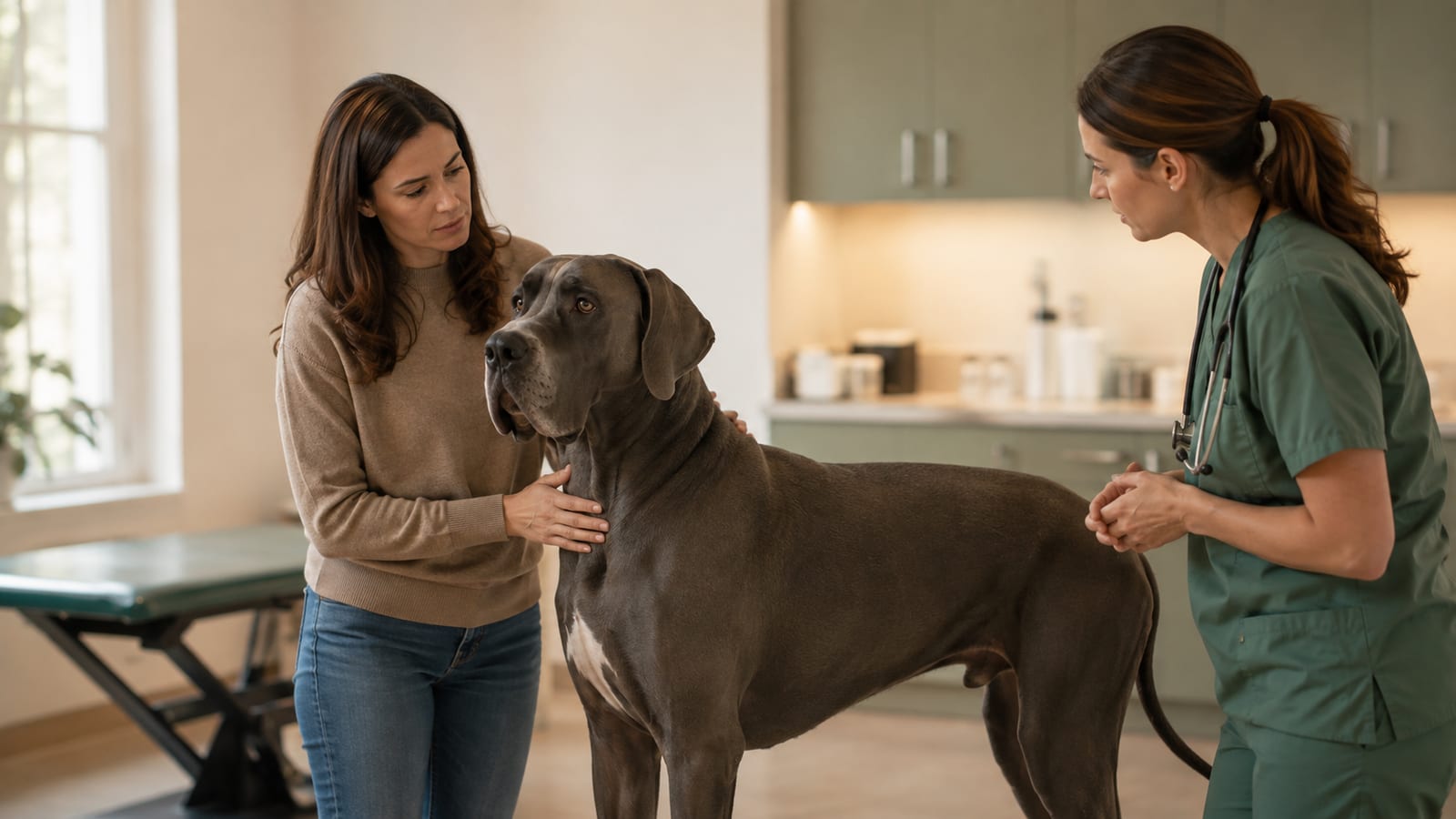
This is a surgical emergency-read this part first
If your dog has a visibly swollen, hard abdomen and is retching repeatedly without bringing anything up, stop reading and call an emergency vet now, or head straight there if one is nearby. Bloat can progress from first signs to a life-threatening state within hours. This is not a "watch and see" situation, and there is nothing safe or effective to do at home-the only treatment is veterinary, often surgical.
The rest of this guide explains what's happening, how to recognize it earlier, and how to reduce your dog's risk-but the paragraph above is the part that matters if you're reading this because your dog is showing signs right now.
What bloat (GDV) actually is
"Bloat" is shorthand for gastric dilatation-volvulus: the stomach fills with gas and fluid (dilatation) and, in the more dangerous form, twists on itself (volvulus). The twist cuts off blood flow to the stomach and can obstruct blood return from the rest of the body, which is why the condition escalates so fast. The American College of Veterinary Surgeons describes GDV as "a rapidly progressive life-threatening condition of dogs that requires immediate medical attention," and reports mortality rates of approximately 15% even among treated cases-higher when complications are present.
Signs to recognize
The ACVS describes the earliest signs as an anxious expression or a dog repeatedly looking round at their own abdomen, standing and stretching, and drooling-often before the abdomen looks obviously distended. Those early signs are the ones most worth knowing, because they buy you time:
- An anxious, "something is wrong" look; repeatedly turning to look at the flank or belly
- Standing and stretching repeatedly, or an inability to settle
- Drooling
- Repeated retching or attempts to vomit that produce little or nothing-one of the most telling signs, and distinct from normal vomiting, which actually brings material up
- Restlessness and pacing
As it progresses:
- Visibly distended, swollen, or hard abdomen
- Panting or laboured breathing
- Weakness, collapse, or pale gums
Any of these, especially in combination in a large or deep-chested dog, is a reason to go now-not to wait for the full picture to develop. A dog does not need to have a visibly swollen belly for this to be GDV; abdominal distension can be hard to see in deep-chested breeds, and its absence is not reassurance. See also the AAHA's owner-facing overview of canine bloat.
What not to do while you're getting there
- Don't wait for it to pass. GDV does not resolve on its own, and every minute of delay costs stomach tissue.
- Don't try to induce vomiting. The stomach may be twisted closed; nothing will come up, and the attempt wastes time and worsens distress.
- Don't give food, water, or medication by mouth, including anti-gas or antacid products marketed for people. They won't relieve a volvulus and can complicate anaesthesia shortly afterward.
- Don't attempt to relieve the gas yourself. Stomach decompression is a veterinary procedure with real risks; there is no safe home version.
- Do call ahead while someone else drives, and say the words "I think my dog has bloat" or "possible GDV"-that phrasing gets a team ready before you arrive, rather than starting triage from scratch at the door.
Why every minute counts
Once the stomach twists, blood flow is compromised to the stomach itself and, as pressure builds, to major blood vessels nearby-this can progress to shock. The stomach tissue can begin to die without blood flow, and the longer this continues, the more of the stomach wall may be damaged beyond saving, and the more the rest of the body is affected by the developing shock. This is why "wait and see if it gets better" is actively dangerous with this specific condition, in a way it usually isn't with a more routine stomach upset.
Who's at higher risk
- Large and giant breeds with deep chests-the ACVS specifically names Great Danes, Weimaraners, St. Bernards, Irish setters and Gordon setters, while noting that nearly all breeds have been reported to develop gastric dilatation, so no breed is truly exempt
- Increasing age-risk rises with each year of age in predisposed breeds
- Eating quickly
- A first-degree relative (parent or sibling) with a history of GDV-there is a genetic component, and it's one of the strongest single predictors
- Being fed one large meal once daily, versus multiple smaller meals
- Elevated feeding (see below)
- Stress
Prevention-including a popular myth worth correcting
- Feed multiple smaller meals rather than one large meal a day, where practical for your dog's routine
- Slow down fast eaters with a slow-feeder bowl or puzzle feeder designed for eating pace (not an elevated bowl-see below)
- Avoid vigorous exercise immediately before and after meals
- Know your dog's individual risk-if you have a large or giant breed with a deep chest, this is worth a specific conversation with your vet about prevention, including whether a preventive procedure makes sense (below)
The elevated-bowl myth: raised feeding bowls are widely marketed and recommended as a bloat-prevention measure, but the research points the other way. A study of large and giant breed dogs published in the Journal of the American Veterinary Medical Association (Glickman et al., 2000) found feeding from a raised bowl associated with an increased risk of GDV, alongside faster eating, increasing age, and having a first-degree relative with a history of GDV. The ACVS likewise lists elevated feeding among the factors that may increase incidence. If you're using an elevated bowl specifically to prevent bloat, that's worth reconsidering; if you use one for an unrelated medical reason such as an orthopedic or oesophageal condition, that's a separate decision to make with your vet-don't remove it on the strength of a web article.
Prophylactic gastropexy: the ACVS notes that preventive gastropexy is currently recommended by many veterinary surgeons for at-risk breeds. The procedure tacks the stomach to the body wall so it can't rotate, and is often performed at the same time as a spay or neuter to avoid a second anaesthetic. Importantly, it does not stop the stomach from distending with gas-it prevents the volvulus (the twist), which is the part that turns bloat into a surgical emergency. If your dog is a high-risk breed, this is worth raising with your vet before a crisis rather than during one.
What happens at the vet
Treatment typically starts with stabilizing the dog (IV fluids, pain control, and decompressing the stomach to relieve pressure), followed by surgery to untwist the stomach and, in most cases, a gastropexy performed at the same time to prevent recurrence-because without it, GDV has a meaningful chance of happening again. Recovery involves monitoring for complications related to the tissue damage that occurred before treatment. None of this is available at home; this is exclusively an emergency/surgical-hospital situation.
FAQ
My dog's stomach looks a little bigger than usual but they're acting normal-is this bloat?
Bloat typically presents with more than just visible swelling-look for the combination of distention with restlessness, unproductive retching, or drooling. That said, if you're genuinely unsure, a call to your vet or an emergency line costs nothing and a wrong guess with this condition is dangerous-when in doubt, call.
Can small dogs get bloat?
It's far less common, but not impossible. The strongest risk factors (large/giant breed, deep chest) don't apply to most small dogs, but any dog showing the signs above warrants the same urgency regardless of size.
Is bloat the same as normal gas or a stomach upset?
No. Normal gas or an upset stomach doesn't typically produce unproductive retching or a hard, visibly distended abdomen, and resolves on its own or with routine care. GDV doesn't resolve on its own, which is the core distinction.
If my dog survives one episode, will it happen again?
Without a gastropexy performed during treatment, there's a meaningful risk of recurrence, which is why it's typically done as part of the same surgery. Ask your vet directly whether one was performed and what that means for future risk.