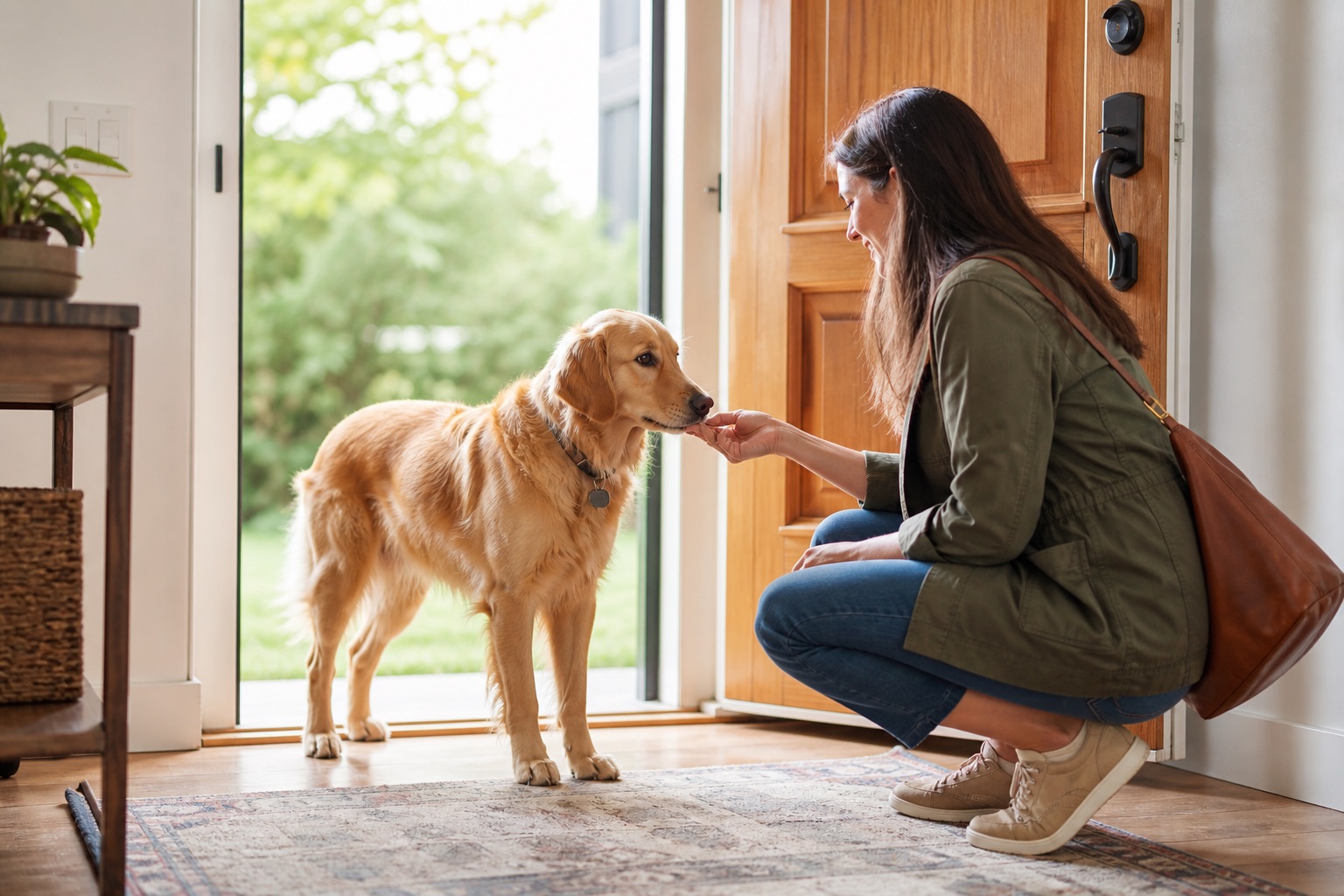
Dogs jump because it has worked: people talk, touch, push, or move in exciting ways. The Best Friends guide to jumping recommends teaching and practicing a proper greeting rather than punishing the dog.
Prevent the dog from reaching visitors while training, then reward the behavior you want. Four paws on the floor, a sit, or going to a mat can all be polite alternatives.
Why jumping keeps happening
Attention is rewarding even when it is negative. Pushing a dog down can become a game, and kneeing can create fear or injury. If one person ignores jumping but another greets the dog while it jumps, the behavior remains strong because intermittent rewards are difficult to extinguish.
Step 1: Manage the doorway
Before opening the door, use a gate, leash, pen, or separate room. Ask visitors to wait while the dog settles. This prevents the dog from practicing a full-speed launch.
If the dog is too excited to respond, do not keep repeating “sit.” Increase distance and make the setup easier.
Step 2: Reward four paws down
Stand quietly and keep your hands still. The moment all four paws touch the floor, mark and feed near the floor. If the dog jumps again, attention pauses. Repeat without shouting.
Once four paws are predictable, add the visitor's approach, a quiet greeting, and a short touch. Reward each successful step.
Step 3: Teach an alternative greeting
Choose one behavior: sit, touch a hand, or go to a mat. Practice it away from the door first. Then ask for it while a familiar visitor approaches. If the dog breaks position, the visitor backs away and the dog gets another easy chance.
Do not require a sit from a dog who is frightened or overwhelmed. Give space and use the body-language guidance in Dog body language and calming signals.
Practice with a staged visitor
Ask one calm helper to follow a written plan. The dog starts behind a gate or on a loose leash. The visitor enters without looking at or touching the dog. When four paws stay down, the visitor can take one step closer; if jumping starts, the visitor turns away and steps back. Repeat at a distance where the dog can still eat and respond.
Once the dog stays grounded, add one small greeting: a hand offered low and briefly, followed by a pause. Do not let the helper crowd the dog or continue petting through signs of discomfort. For a large or powerful dog, keep the barrier or leash management in place until the behavior is reliable with several people.
Generalize beyond the front door
Dogs may jump at the garden gate, in a car park, at a café, or when a family member returns home. Practice the same four-paws-down rule in each setting, starting far from the excitement. A mat, hand target, or sit can be the alternative, but calm access to people should also be valuable on its own.
Children, guests, and deliveries
Use management around children and people who cannot follow instructions. For deliveries, keep the dog behind a barrier. Ask regular visitors to ignore jumping and reward calm behavior consistently.
Troubleshoot common setbacks
If jumping returns after a quiet week, look for a new rehearsal: visitors may have been greeting at the door, the dog may be jumping during leash clipping, or a child may be running past. Return to the barrier-and-helper setup and reward the first calm choice. If the dog cannot respond, reduce excitement before asking for a behavior.
For a dog who jumps on walks, create distance from approaching people and reward four paws down before the person reaches you. Ask strangers not to reach over the dog. For a dog who jumps from fear or tries to avoid touch, do not force a greeting; use the body-language guide and professional support.
A visitor script that works
Tell the helper: “Please ignore the dog at first. If four paws leave the floor, turn away and wait. When the dog is grounded, reward calmly and only then offer a brief greeting.” This removes mixed signals and makes the exercise repeatable. If the dog is too excited to eat, move the helper farther away or use a gate.
The household standard
Choose one greeting rule and use it every time: attention arrives when four paws are down, and attention pauses when jumping begins. Pair that rule with barriers and short practices so the dog is not repeatedly rewarded by accident. The standard should be realistic for the dog's age, health, size, and emotional state.
Before the door opens
Set up the leash, gate, treats, and visitor instructions before the knock. Preparation prevents the first greeting from becoming the biggest rehearsal of the day. Release the dog from the exercise only when the visitor is settled and the dog can make a calm choice.
Keep greetings short at first
End the greeting while the dog is successful, then give a calm break behind the barrier. Several brief repetitions teach more than one long, chaotic visit. Increase the visitor's movement and excitement only after the dog can stay grounded with ordinary greetings.
FAQ
Should I push my dog down when it jumps?
No. Pushing can reward the behavior or create conflict. Turn away, manage access, and reward four paws down.
How long will it take to stop jumping?
Progress depends on consistency and how long the dog has practiced. Expect improvement in easy settings first, then generalize to exciting visitors.
What if my dog jumps because it is excited?
Lower the intensity, pause access to the person, and reinforce a calm alternative. Excitement is a reason to make the exercise easier, not to shout louder.
Is jumping aggression?
Usually it is an over-excited greeting behavior. Stiffness, fear, growling, biting, or unsafe size/strength requires professional assessment.