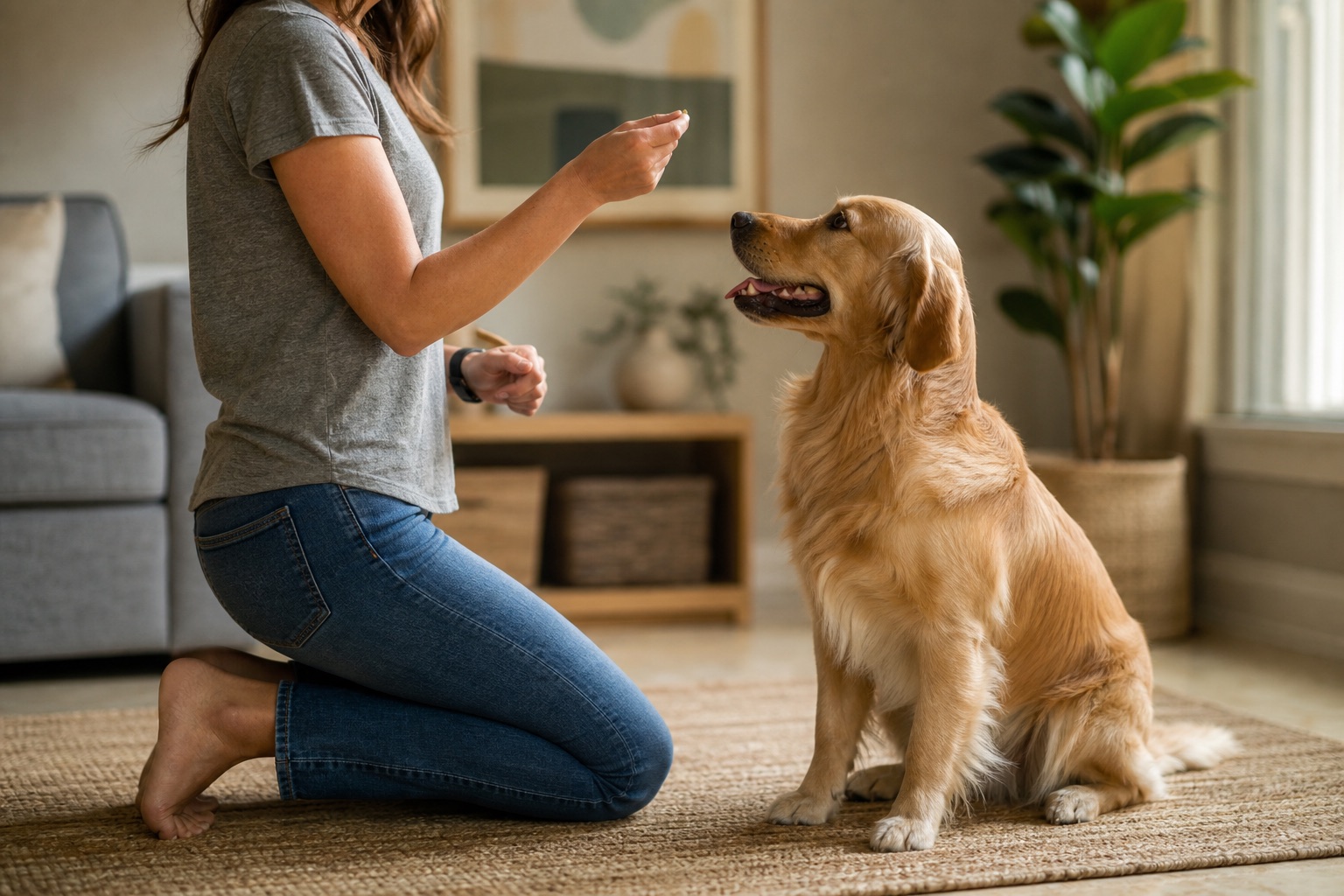
Basic obedience training is communication practice. Use a reward your dog values, keep sessions short, and make the correct behavior easy before adding distractions. AKC's basic obedience guidance emphasizes positive reinforcement and rewarding the dog for making the right choice.
Do not repeat a cue until the dog guesses correctly, physically force a posture, or use “stay” to keep a frightened or reactive dog in a situation it cannot handle. Train the skill and manage the environment separately.
Teach sit
Hold a treat near your dog's nose and slowly move it slightly up and back. As the dog's bottom touches the floor, mark and reward. Add the word “sit” when the movement is already predictable. Practice from standing, beside a chair, and before ordinary rewards such as a door opening or food bowl.
If the dog jumps for the treat, lower your hand and wait. Do not push the rump down. Reward a voluntary sit instead.
Teach down
From a sit or stand, move a treat from the dog's nose toward the floor and slightly forward. Mark the moment the elbows reach the ground. If the dog stands, make the movement smaller and reward earlier steps.
Practice on a comfortable surface. Some dogs dislike cold, slippery, or hard floors; that is a setup problem, not disobedience.
Teach stay as duration, distance, and distraction
Ask for a sit or down, pause for one second, mark and reward, then release. Add seconds gradually. Later add one step of distance, then return and reward. Distractions come last.
Change only one factor at a time. If the dog breaks position, calmly reduce the difficulty rather than repeating “stay” louder. Use a release word such as “okay” so the dog knows when the exercise ends.
Use rewards strategically
Choose food, play, sniffing, praise, or access to something the dog actually wants. Deliver the reward immediately after the behavior, then gradually make the exercise less dependent on a treat being visible in your hand. Keep a few rewards available in ordinary rooms so good choices can be reinforced when they happen naturally.
If the dog refuses a reward, do not assume stubbornness. The environment may be too distracting, the dog may be tired or worried, or the reward may not compete with the trigger. Make the task easier and check whether a health or pain issue could be affecting participation.
Build useful everyday habits
Practice before meals, at doorways, beside the car, and during calm greetings. Reward check-ins, waiting, turning away from dropped food, and settling. Obedience is strongest when it is reinforced in ordinary life, not only in a formal session.
Keep children from giving repeated cues or grabbing a dog into position. Everyone should use the same words and rewards.
Make the three cues reliable
Add duration without frustration
For stay, begin with one successful second and release immediately. Build several easy repetitions before adding another second. If the dog leaves, shorten the duration and reward sooner rather than repeating the cue louder. A dog that can hold a stay in a quiet room may still need a one-second version when a visitor arrives.
Add distance separately
Take one half-step away, return, and reward. Then try one full step. Keep the dog within easy reach until the behavior is consistent. Add distractions only after distance is comfortable, and change one factor at a time.
Generalize the words
Dogs do not automatically understand that “sit” means the same thing in a kitchen, on a sidewalk, and at a veterinary clinic. Practice in several safe locations with the same cue and reward pattern. Have family members take turns so the dog learns the behavior is not dependent on one person's posture.
A simple practice plan
Start with one cue in a quiet room. Over the next few days, alternate sit, down, and brief stay in short sessions. During the second week, practice before meals, at a doorway, and beside a parked car. Record the easiest and hardest version so you can progress deliberately instead of increasing every variable at once.
What not to do
- Do not force the body into a sit or down.
- Do not punish a dog for breaking a stay.
- Do not practice in a distracting place before the behavior is fluent.
- Do not use obedience cues to suppress fear, pain, aggression, or panic.
- Do not expect a puppy or dog to hold a position beyond comfort or physical ability.
Know when to stop a session
End while the dog can still succeed. Signs that the session is too difficult include wandering away, refusing a familiar reward, repeated errors, grabbing treats roughly, yawning or scanning in a tense context, and escalating frustration. Give a break, meet basic needs, and return later at an easier level. Short, successful practice builds more reliability than drilling until the dog shuts down.
Make cues cooperative
A cue should help the dog understand what will earn reinforcement, not become a threat. If a dog cannot perform, reduce the difficulty or manage the environment. Never use sit, down, or stay to hold a fearful dog beside a trigger. Emotional safety and physical safety come before a polished response.
Reward the smallest correct response
A head turn, elbow bend, one-second pause, or step toward the mat can be the beginning of the finished behavior. Mark that improvement and build gradually. Dogs learn faster when the criteria are clear enough that they can succeed repeatedly.
FAQ
How long should obedience sessions be?
Short sessions ending while the dog is successful are better than one long, frustrating session. Adjust for age, health, and attention.
Should I train before or after exercise?
Both can be useful. A brief sniff or play period may help an energetic dog focus, while calm training can then teach settling. Avoid training when the dog is exhausted or overheated.
Why does my dog obey at home but not outside?
The behavior has not generalized. Return to an easier version and add one distraction at a time.
Is obedience training enough for aggression or reactivity?
No. Use the appropriate behavior and safety guides and seek professional help for risk concerns.