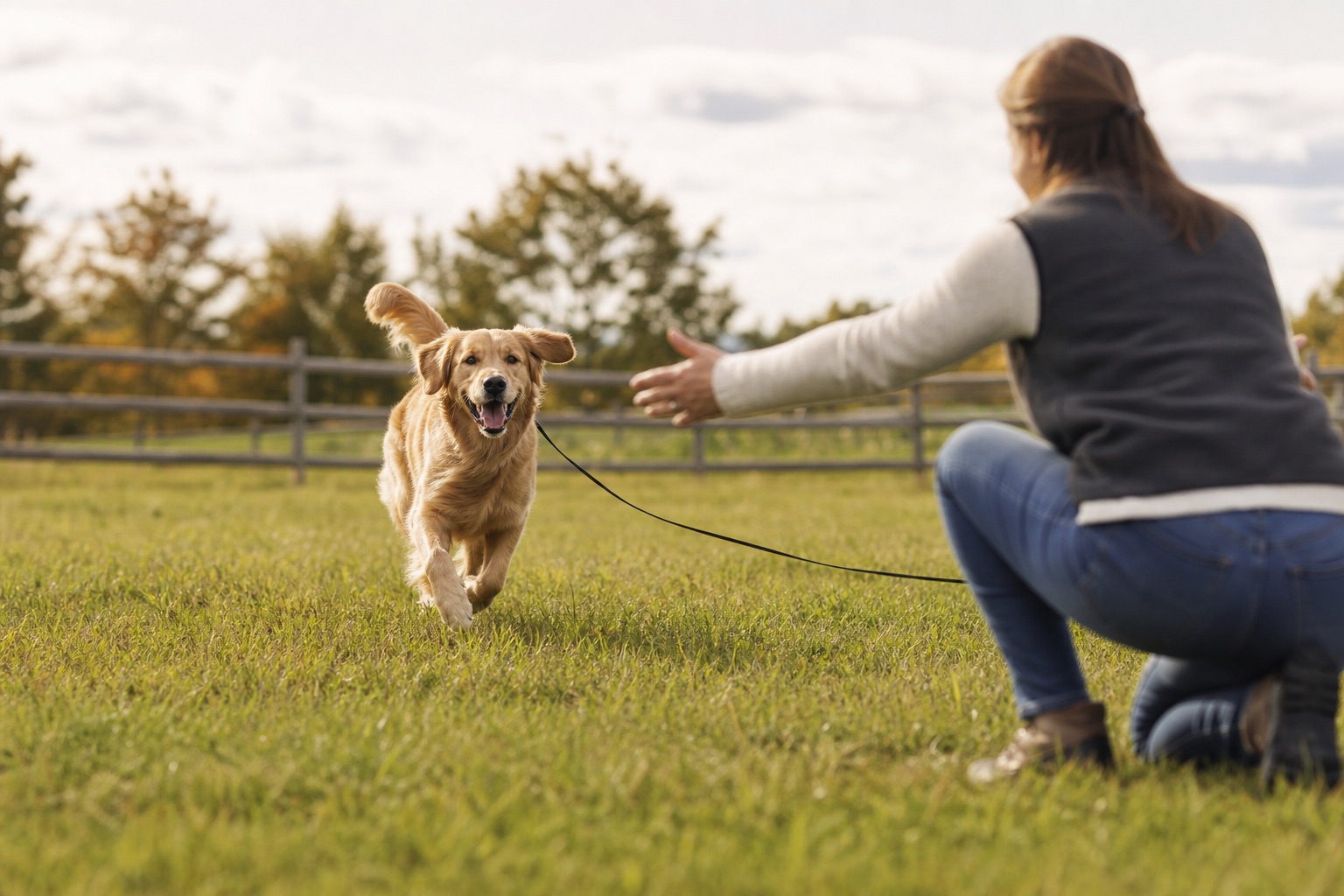
Recall training teaches a dog that turning toward you and coming close is worthwhile. AKC's reliable-recall guidance recommends making the behavior rewarding and practicing safely before expecting reliability.
Start with a cheerful cue such as “here,” reward generously, and release the dog back to something enjoyable. Use a long line and enclosed area outdoors. A recall is a safety skill, not a test of whether your dog loves you more than a squirrel.
Choose a recall cue
Pick one word and keep it consistent. If “come” has been shouted during punishment or repeated without success, choose a fresh cue and teach it from the beginning. Everyone in the household should know the word and reward plan.
Build the behavior indoors
Say the cue once in a happy voice when your dog is already close. Move backward, open your body, and reward when the dog follows. Practice between two people, then from another room. End with a release so coming to you does not always end freedom.
Never call a dog and then do something frightening, grab roughly, or scold it. Go to the dog or use management when you need immediate control and the recall is not ready.
Add distance and a long line
Move to a fenced yard or quiet enclosed space. Use a long line attached to a secure harness or collar setup, and let the dog explore. Call when the dog is likely to succeed, reward at your feet, and release again.
Increase one difficulty at a time: distance, smell, movement, other people, then calm dogs at a safe distance. If the dog ignores the cue, the environment is too difficult or the reward is not competitive enough.
Strengthen the last two steps
Many owners practice the dog running toward them but forget the part that matters in an emergency: arriving close enough to secure safely. Reward the approach, then feed several small treats while you touch the collar or harness gently. Release the dog again when safe. Practice this separately so a collar touch does not always predict the end of fun.
Use a special emergency cue only after ordinary recall is fluent. Pair it with an unusually valuable reward in easy settings, use it rarely, and replace the reward generously after a real emergency. If the dog has a history of being chased or grabbed, rebuild the final approach slowly with a professional.
Make recall games part of life
- Run away a few steps and reward the chase.
- Take turns calling between family members.
- Hide nearby and celebrate the search.
- Reward spontaneous check-ins.
- Practice emergency recall with a special word and exceptional reward.
Do not overuse the emergency cue. Save it for situations where you can reward heavily.
Readiness checklist before more freedom
Before unclipping a long line, check whether your dog can:
- turn toward you promptly from mild distractions;
- come all the way to you rather than stopping several feet away;
- allow a collar or harness touch without backing away;
- return after being released to sniff or play; and
- repeat the behavior in more than one safe location.
This is a practical checklist, not a guarantee. Wildlife, traffic, water, unfamiliar dogs, and open gates can overwhelm a previously reliable recall. Continue using a leash or long line wherever the environment or local rules require it.
Troubleshoot a recall that falls apart
If the dog approaches and veers away, reward the approach before reaching for the collar, then practice a gentle collar-touch game separately. If the dog comes close but will not be caught, crouch sideways, feed several treats, and calmly secure the leash. If the dog ignores the cue, do not repeat it across the field; shorten the distance or change the environment.
Avoid calling only for unpleasant events such as nail trims, crate time, or leaving the park. When you must end an activity, reward the recall and add a second enjoyable step when possible, such as a sniff break or treat scatter near the car.
Off-leash safety
Follow local leash laws and use fenced areas until the recall is dependable around real distractions. A dog can have excellent home recall and still fail near wildlife, roads, water, or another dog. Continue using a long line when the consequence of failure is serious.
Measure recall without gambling with safety
Track the percentage of successful responses, the distance, the distraction, and how quickly the dog reaches you. Practice only in spaces where a missed response cannot lead to traffic, wildlife, water, or an unwanted dog encounter. Reliability is built through many safe repetitions; one dramatic test is not evidence that off-leash freedom is ready.
Keep the cue valuable
Reward spontaneous check-ins and easy recalls throughout the week, not only when you need to leave the park. Occasionally release the dog back to safe exploration so returning does not always predict the end of freedom. If a recall has been repeated unsuccessfully, pause use of that cue and rebuild it in a simpler setting with stronger reinforcement.
Practice the approach separately
Call the dog a short distance, reward the turn, then reward again when the dog reaches you. Touch the harness, feed, and release. This sequence protects the final step that matters when you need to secure the dog near a gate, road, or veterinary clinic.
Keep the long line safe
Use a line long enough for practice but short enough to avoid tangling around people, dogs, trees, or wheels. Attach it to equipment the dog cannot slip. Do not wrap it around a hand or use it to jerk the dog toward you.
FAQ
Why does my dog come at home but not outside?
Outdoor distractions are stronger. Return to a quiet area, use a long line, and increase difficulty gradually.
Should I punish a dog who ignores recall?
No. Punishment makes returning less safe. Manage the dog, reduce the difficulty, and rebuild the association.
How many times should I call?
Say the cue once, then help the dog succeed rather than repeating it until it loses meaning. Improve the setup for the next repetition.
Can recall training work for a reactive dog?
Recall can help management, but it does not replace trigger and threshold work. See reactive dog training for that problem.