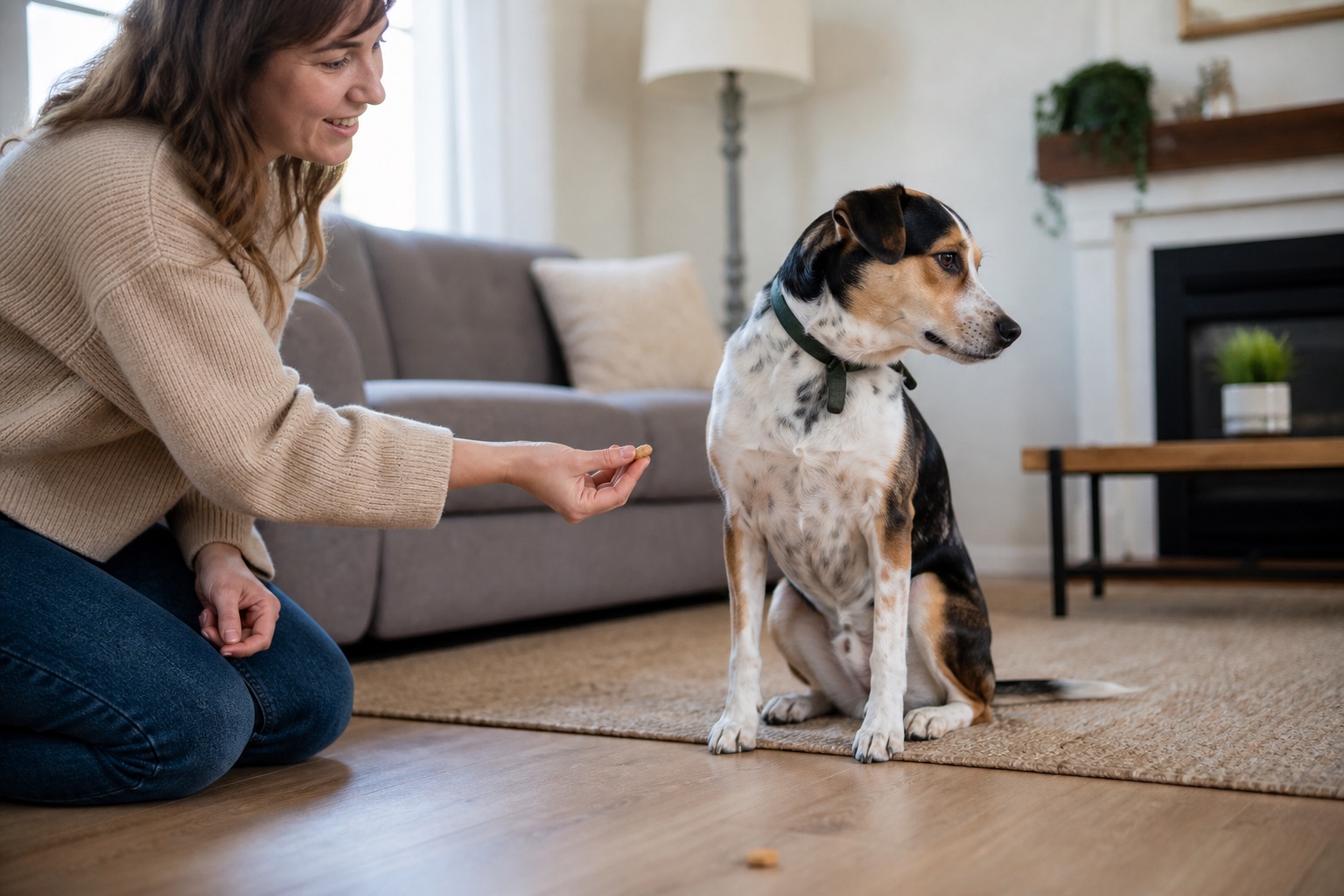
“Leave it” and “drop it” solve different problems. Leave it is taught before the dog takes an item; drop it is taught when the item is already in the mouth. AKC's leave-it lesson and drop-it lesson both use reward-based exchanges.
These cues are not permission to take food or toys whenever you want. Repeatedly removing valuable items can create guarding. If the dog stiffens, growls, snaps, or has a bite history, stop and read Dog resource guarding.
Teach “leave it”
Place a boring treat in a closed hand. Let the dog sniff. The moment the dog moves away, mark and reward from the other hand. Add the words only after the dog reliably backs off.
Progress to an open hand, a treat on the floor under your foot, and then a low-value object while you supervise. Reward the dog for looking away and returning attention to you. Increase difficulty slowly.
Never use the cue to lure a dog into a dangerous object or allow the dog to rehearse grabbing it. Manage the environment first.
Teach “drop it”
Start with a toy the dog enjoys but does not guard. Play briefly, hold a high-value treat near the nose, and wait for the mouth to open. Mark the release, feed, and return the toy when safe. This teaches that dropping does not always mean permanent loss.
Add the verbal cue as the dog begins to release. Practice with different safe toys, not stolen items or dangerous objects at the start.
When your dog steals something
Stay calm, prevent chasing, and trade for something better if the item is safe to approach. Secure the unwanted object after the dog moves away. If the dog has swallowed medication, toxic food, a sharp object, or a large item, call your veterinarian or an emergency service immediately rather than waiting for training.
Build both cues in small steps
For leave it, begin with an uninteresting item and a closed hand. Progress to an open hand only when the dog can look away without pawing or grabbing. Then place the item on the floor while your foot remains available as management. Reward from your other hand, not by allowing the dog to take the original item.
For drop it, start with a safe toy and a trade that is clearly worth making. After the dog releases, mark, reward, and return the toy when appropriate. Add a short pause before returning it only after the release is fluent. This keeps the cue cooperative rather than turning every play session into a confiscation drill.
Never rehearse either cue with medication, sharp objects, toxic foods, or a guarded chew. Those are safety-management situations. Use a barrier, prevent access, and contact a veterinarian or emergency service when ingestion may have occurred.
Children should not take objects from a dog's mouth or test leave it around food. Teach them to call an adult, move away, and avoid chasing if a dog picks something up.
Resource-guarding boundary
Do not reach into a dog's mouth, take food from a bowl, or practice “drop it” around a guarded bone. A growl is a warning, not a challenge. Punishment can make the situation less predictable. Use barriers and professional guidance.
Practice without creating conflict
Keep sessions separate from moments when you urgently need the object. Start with two safe toys of different value, trade the lower-value toy for the higher-value one, and return the first toy after the release. When the dog is fluent, practice with a supervised household item that is safe and boring. Stop while the dog is still relaxed.
If the dog swallows something dangerous, training is no longer the priority. Contact a veterinarian or poison service immediately and follow its instructions; do not induce vomiting unless directed. If the dog stiffens, freezes, growls, or snaps over an object, use distance and barriers and move to the resource-guarding plan rather than trying a stronger cue.
Make the cues useful outside practice
Use leave it around a boring leaf, a piece of paper, or a low-value toy before expecting it near food on a sidewalk. Use drop it during calm toy play before you need it for a stolen object. Reinforce the cue even when the reward is praise, another toy, or distance from the distraction. Then manage the environment so the dog is not repeatedly rehearsing the dangerous choice.
Keep the emergency plan separate
Leave it and drop it are learned skills, not substitutes for securing hazards. Use closed doors, lidded bins, child locks, and supervision to prevent access to medication, batteries, chemicals, and toxic foods. If the dog has already swallowed something dangerous, contact a veterinarian or poison service rather than testing a newly trained cue.
Reward the decision, not just the release
Mark the moment the dog disengages from the item or opens its mouth. Deliver the reward promptly and calmly. If you wait until the dog has wandered away, timing becomes unclear. End with an easy success so the dog remains willing to play the exchange game.
Adjust the reward to the object
A piece of kibble may beat a boring toy but not a stolen roast. Start with easy trades and increase the reward only when the object's value increases. If the dog will not trade, stop approaching, create distance, and use management rather than escalating the cue.
FAQ
Are leave it and drop it the same cue?
No. Leave it means do not take the item; drop it means release an item already held.
Should I take toys away to teach drop it?
No. Trade and return safe toys so the cue predicts good outcomes rather than loss.
What if my dog runs away with an object?
Avoid chasing. Use a calm trade and manage access to the environment. Seek help if the dog guards the object.
Can these cues prevent resource guarding?
They can support cooperative habits, but they are not a treatment for guarding. Stop if guarding signals appear.