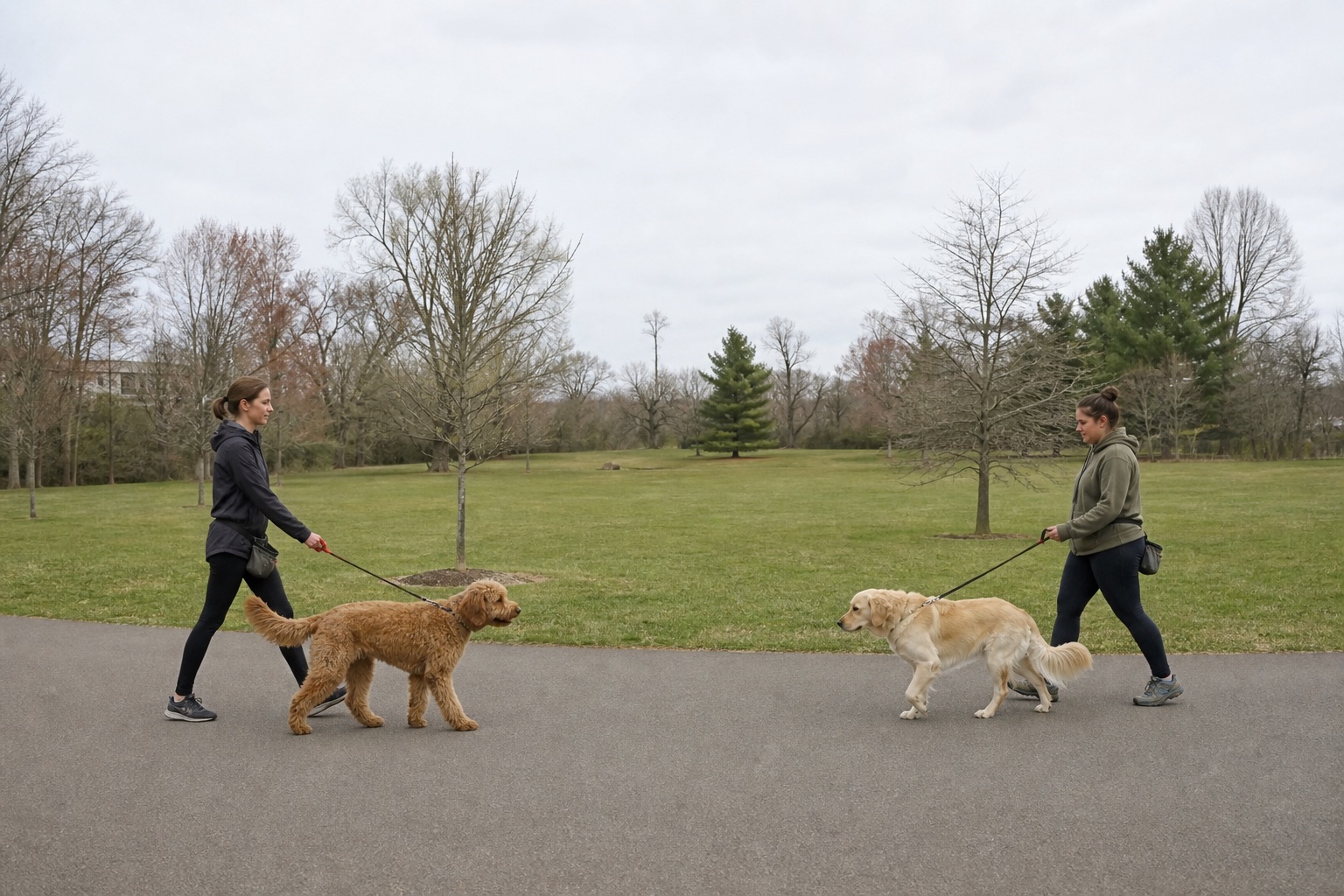
The safest dog introductions are gradual. Use two handlers, a neutral or low-conflict location, secure equipment, and enough distance for both dogs to remain responsive. Start with parallel walking, then allow brief curved approaches only if the dogs stay loose and can disengage.
The Animal Humane Society introduction guide recommends neutral-territory work and watching for body-language changes. Best Friends Animal Society also emphasizes separating before dogs reach high arousal.
Before the first meeting
Check that both dogs are healthy, safely contained, and able to leave the situation. Avoid introducing a dog who is ill, injured, exhausted, or already overexcited. Remove food, bones, and favorite toys from the home before a resident dog meets a newcomer indoors.
Use adult handlers who can move calmly. Do not wrap leashes around hands, use retractable leads for the first meeting, or allow children to manage the dogs.
Choose the meeting conditions carefully
Use two handlers who can control their own dogs without wrapping leashes around their hands. Choose a neutral, open place with room to move away, not a narrow doorway or crowded dog park. Remove food, toys, and other high-value resources from the first meeting. If either dog is ill, injured, exhausted, or already showing fear, postpone and ask a professional for a tailored plan.
Before the dogs see each other, agree on an exit route and a signal to pause. Start far enough apart that both dogs can sniff, take food, and respond to their handlers. Distance is not failure; it is what keeps the first repetitions below the point where body language becomes difficult to read.
Step 1: Begin at a distance
Start far apart in a quiet outdoor area. Walk in the same direction without forcing the dogs to look at each other. Reward calm glances, sniffing, loose movement, and checking in with the handler.
If either dog freezes, stares, pulls hard, hides, growls, or stops taking food, increase distance. The goal is not to reach the other dog quickly; it is to keep both dogs under threshold.
Step 2: Parallel walking
Gradually close distance only while both bodies remain loose and movement stays easy. Keep walking rather than stopping for a long, head-on confrontation. Change sides, add gentle curves, and give breaks.
Do not interpret a wagging tail alone as permission to approach. Read posture, face, speed, and the ability to turn away.
Step 3: Brief investigation
If the dogs remain comfortable, allow a short curved approach. Call them apart, reward, and resume walking. Repeated short greetings are safer than one prolonged, intense interaction.
Healthy play can include pauses, role reversals, loose movement, and both dogs choosing to return. One dog repeatedly chasing, pinning, hiding, or trying to escape is not balanced play.
Keep the first home visit structured
After a successful neutral walk, allow the dogs to enter a prepared home with separate resting spaces. Feed separately and keep chews, toys, and bowls out of shared access at first. Use gates and short supervised periods together, followed by rest. Do not leave dogs loose together simply because the first greeting looked friendly.
Expect adjustment to take longer than one meeting. Calm parallel time, choosing to disengage, and resting in the same area are useful progress even when there is no play.
Step 4: Bringing a dog into the home
Walk together before entering. Keep the first indoor session short and remove resources that could create conflict. Use gates, separate resting areas, and supervised interactions. Feed dogs separately and do not leave them together until the relationship has been observed across ordinary routines.
Allow the resident dog to keep a safe retreat. The newcomer should not be allowed to follow, corner, or repeatedly climb over a dog who is asking for space.
Warning signs and when to stop
Stop the interaction if either dog becomes stiff, freezes, hard-stares, shows teeth, growls, repeatedly avoids, lunges, or cannot disengage. Calmly create distance; do not punish the warning. If there is a bite, fight, or repeated escalation, separate safely and contact a veterinarian or qualified behavior professional.
Dogs with a history of aggression or severe reactivity should not be introduced using a generic internet protocol. Use in-person professional planning.
Common mistakes
- Forcing a nose-to-nose greeting
- Letting leashes become tangled
- Introducing dogs over food or toys
- Waiting until one dog is already barking or lunging
- Allowing children to participate in the first meeting
- Assuming a successful first minute means the dogs can be left alone
Progress is more than play
A successful introduction may look quiet: both dogs sniff, walk in curves, respond to handlers, take breaks, and choose to look away. Play is not required, and a long play session can hide rising arousal. End while the dogs are still comfortable, then give each dog separate rest and resources.
Give both dogs an exit
A handler should always be able to increase distance without pulling either dog into a confrontation. Keep pathways open, avoid wrapping leashes around objects, and do not allow a crowd to close in. If a dog chooses to leave, let that choice end the interaction. Respecting disengagement is one of the most useful preventive habits in a first meeting.
Stop on a good repetition
Do not keep walking closer because the previous step went well. Pause, separate, and allow recovery. Ending while both dogs are comfortable protects the next meeting and makes the new relationship easier to build.
FAQ
Should dogs meet on leash or off leash?
Secure leashes and two handlers are useful for gradual management. Off-leash interaction should happen only in a safe, enclosed setting and only when the dogs' history and body language support it.
How long should the first meeting last?
Short enough to finish while both dogs are still comfortable. Several brief sessions are usually easier to read than one long meeting.
What if one dog growls?
Increase distance and stop the pressure. Do not punish the growl. Repeated growling, snapping, or lunging requires professional help.
Can a reactive dog meet another dog?
Sometimes, but the plan must be individualized. Start with the reactive-dog training guide and involve a qualified professional for safety concerns.