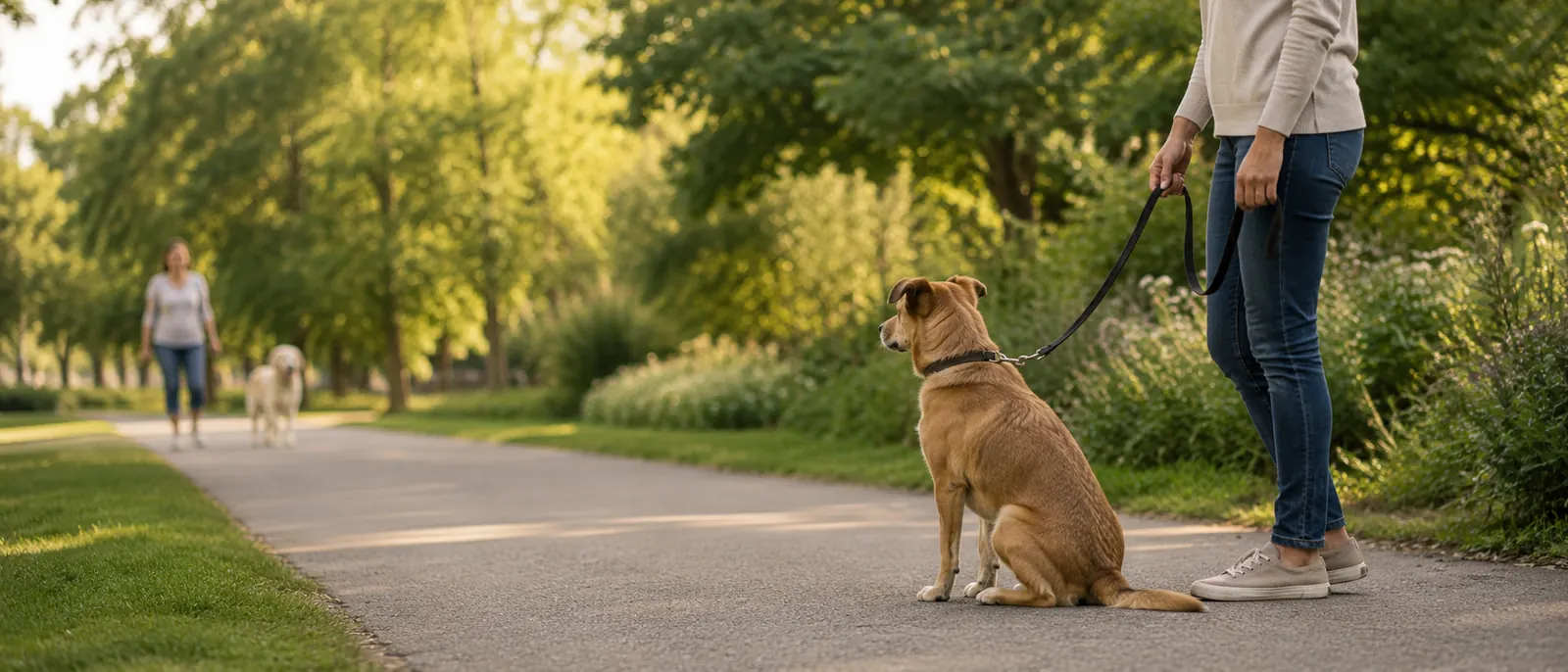
What Does "Reactive" Actually Mean?
Cornell University's Riney Canine Health Center describes a reactive dog as one who "overreacts to normal situations that other dogs would take in stride" — becoming "overly aroused by common stimuli" in ways that can include lunging, barking, and growling. That's a useful working definition: reactivity is an intensity problem (too big a response, too fast) more than it is a hostility problem.
Reactive is not automatically the same thing as aggressive. A lot of reactive behavior is arousal or fear expressing itself loudly — barking and lunging to increase distance from something the dog finds overwhelming — rather than a genuine intent to bite. That said, the two can overlap in a real dog, and reactivity that includes snapping, repeated lunging with intent to make contact, or any bite history has crossed into territory this article's at-home plan isn't written for. See When to Call a Professional if that describes your dog.
Common Triggers
Most commonly: other dogs, unfamiliar people, bikes, skateboards, and cars, and sudden or unexpected noises. Some dogs react to one narrow category; others generalize to several.
Leash Reactivity vs. Other Contexts
This guide focuses on leash/walk reactivity specifically, since it's the most common and most disruptive context, and the one a structured on-walk plan can most directly address. Related but distinct patterns include fence-running (barking at things through a yard fence), window or doorbell alerting, and reactivity in a car or crate. The same underlying principles — distance, desensitization, avoiding flooding — generally apply, but the practical setup is different enough that this article won't cover them step by step. If what you're actually dealing with is barking unrelated to a specific passing trigger — boredom, attention-seeking, or barking when left alone — that's a different problem with a different fix; see Why Your Puppy Won't Stop Barking.
Why Dogs Become Reactive
Cornell's guidance points to several overlapping causes: genetic predisposition, insufficient socialization, prior negative experiences, and a lack of training — noting that while genetics can play a role, reactivity is "more likely due to a lack of socialization, prior bad experiences, or a lack of training." The AVSAB's position statement on puppy socialization backs the socialization piece specifically, stating that "incomplete or improper socialization during this important time can increase the risk of behavioral problems later in life including fear, avoidance, and/or aggression," and identifies the first three months of life as the primary window for this kind of adaptation.
None of this means an adult reactive dog "missed their chance" — the window described above is about prevention, not a claim that later behavior work doesn't help. It does mean that, as with resource guarding, this is generally better understood as a fear- or arousal-driven pattern than a defiance problem, which shapes which fixes actually work (see What Not to Do).
Which Breeds Are More Prone to Reactivity?
Unlike some behavior topics where the research is thin, there's real, credible science on breed-level heritability of behavior traits. A large genetics study covered by Science News found that traits including fearfulness show a genetic contribution of around 50%, "suggesting that differences in environment or training play an equally important role in shaping those behaviors." Critically, the researchers' own caveat is directly relevant here: as one behaviorist quoted in the piece put it, owners "shouldn't take it to mean that their dog's personalities are totally innate and predetermined," because "there's still an enormous amount of variation among individual dogs." So, "an individual is better treated as an individual, rather than as a representative of its breed."
In practice: breed and genetics are a real part of the picture, but roughly half the story (by this research) is environment and training — both things you can actually influence — and individual variation within any breed is large enough that breed alone won't tell you what your specific dog needs.
The Core Skill: Finding and Working at Your Dog's Threshold
Most of what actually helps a reactive dog comes down to one skill: working at a distance and intensity where your dog can notice a trigger without being overwhelmed by it, and gradually closing that gap. Trainers and behavior consultants commonly call this working "at threshold" or "under threshold" — this section explains what that means in practice and how the step-by-step plan below uses it. Cornell's own guidance reflects the same underlying idea without using that specific term, recommending you "give the reward at a safe distance from the trigger... so that your dog feels comfortable," and, for dogs that react to people, suggesting you initially "keep an entire soccer field" of distance if that's what it takes.
What "Threshold" Means and How to Identify It
Under threshold: your dog notices the trigger (ears perk, a glance toward it) but can still take treats, respond to their name, and generally function — this is the zone where training actually works.
At or over threshold: your dog fixates, stops responding to you, stiffens, or moves straight into barking/lunging. Once a dog is over threshold, they're not learning anything useful — they're just having (and rehearsing) the reaction you're trying to reduce. If you find yourself repeatedly at this point, the fix isn't pushing through — it's more distance, or a shorter/easier session.
Why Getting Too Close Too Soon Backfires
The AVSAB's position statement on humane dog training specifically endorses "systematic desensitization (as opposed to flooding or exposure)" as the appropriate approach for fear- and arousal-based behavior. Flooding — forcing continued exposure to something overwhelming until the dog "gets used to it" — is a real risk in reactivity work because it's tempting ("just let them meet a dog and get over it"), and it reliably makes things worse rather than better by rehearsing panic instead of resolving it.
A Step-by-Step Training Plan
As with any behavior-modification plan, this is a criteria-based progression, not a fixed schedule. Move to the next phase only when your dog is reliably successful at the current one across multiple separate sessions — not because a certain number of days or walks have passed. Some dogs move through a phase in days; others need weeks. Both are normal.
If at any point your dog snaps, attempts to bite, or a reaction escalates in intensity rather than staying level or easing, stop immediately and move to When to Call a Professional — none of the phases below are written for a dog already showing that.
Phase 1 — Building Focus
Before working around any real trigger, build a reliable "look at that" response in a trigger-free environment: mark (with a clicker or a word like "yes") and reward the instant your dog notices something in the distance, before any reaction starts. This teaches your dog that noticing something can be followed by something good, rather than by escalating arousal — it's the foundation everything else in this plan builds on. Success criteria to advance: your dog reliably takes the mark-and-reward pattern with low-key novel objects/sounds in a calm setting.
Phase 2 — Threshold Distance Work
- Find a starting distance from a real trigger (a person, a parked car, a dog-walking route at a quiet time) where your dog notices it but stays under threshold — able to take treats and respond to you. If you're not sure where that is, start farther away than you think you need to.
- Mark and reward calm noticing at that distance, repeatedly, across separate short sessions.
- Success criteria to advance: your dog consistently stays under threshold and re-engages with you at this distance, not just once but across multiple sessions and multiple exposures to the trigger.
Phase 3 — Gradually Closing Distance
Decrease the distance in small increments, only after your dog is reliably successful at the current distance. If your dog goes over threshold at a new distance, that's information, not failure — move back to the last distance that worked and get more repetitions in before trying again. Success criteria to advance: the same calm, responsive behavior at each shorter distance, consistently.
Phase 4 — Real-World Generalization
Practice in different locations, at different times of day, and with different specific triggers (not just the one you trained with) — always starting back at a larger distance in a new context, the same way a dog that's calm at home might still need distance on an unfamiliar street. Generalization is often the slowest phase, and that's normal, not a sign the plan isn't working.
If at any point your dog's reactions get worse rather than better, or you reach a point where you don't feel safe continuing, stop and see When to Call a Professional rather than pushing forward on your own.
Equipment That Helps
A front-clip harness is a common recommendation for leash work generally, not specifically a fix for reactivity on its own — the mechanism is mechanical, not behavioral: as Best Friends Animal Society explains, front-clip harnesses "work by having leash pressure direct the dog to the side instead of allowing them to lean into the harness and pull forward," which gives you more physical control during training sessions. They're not perfect for every dog — the same source notes they "can cause chafing and may be difficult to fit correctly on some body types," so fit matters.
A long line (a longer, lightweight leash used in open, controlled spaces) can help during threshold-distance work by letting you find a comfortable distance without being right on top of a trigger. A treat pouch and genuinely high-value treats make the mark-and-reward mechanics above much easier to execute consistently — this matters more than any specific brand.
What we won't recommend for this: prong collars, choke chains, or e-collars/shock collars. These are commonly marketed for exactly this problem, but they work through discomfort or pain rather than changing the underlying fear or arousal driving the reaction — and per the AVSAB position statement cited above, there's "no evidence that aversive training is necessary for dog training or behavior modification." Using a startling or painful correction on a dog that's already over threshold also risks teaching the dog that the trigger itself predicts pain, which can make reactivity worse, not better.
What Not to Do
- Flooding — forcing continued exposure to an overwhelming trigger to make the dog "get over it." See above.
- Prong collars, choke chains, e-collars, or physical corrections in response to reacting.
- Yelling or leash-jerking when your dog reacts. The AVSAB's position statement on dominance theory notes that confrontational techniques can "directly exacerbate the problem by increasing the animal's fear or anxiety" — the same logic applies to a dog that's already over threshold and reacting.
- Treating a reacting dog as defiant. A dog that's barking and lunging at the end of a leash is, in the moment, overwhelmed — not choosing to disobey you.
- Testing progress by deliberately closing distance to "see how they do." This risks a real setback for no training benefit; if you want to check progress, do it at a distance you already know works, and look for signs of increasing comfort, not by pushing closer than planned.
Realistic Timelines and What "Better" Looks Like
There's no honest way to promise this resolves on a fixed timeline, or that it fully "cures" every dog. What's genuinely true: many reactive dogs improve significantly with consistent, structured work, especially when it starts with a real assessment of where their threshold actually is rather than guessing. "Better" often looks incremental rather than dramatic: your dog needs less distance than before to stay calm, recovers faster after a reaction happens, or has fewer full-blown reactions per walk — not necessarily zero reactions ever again. For some dogs, especially those with a longer reactive history, ongoing management (route choices, distance awareness) alongside training is the realistic long-term picture, the same way it can be for resource guarding.
When to Call a Professional
This isn't a softened list — if any of the following apply, the right move is a qualified behavior professional, not a longer attempt at the plan above:
- Any bite history, or any incident where skin was broken.
- There are children in the household.
- Any snapping, with or without contact — including a single instance.
- Repeated lunging at people or dogs.
- Reactivity combined with other aggressive behavior — for example, a dog that also resource guards or shows territorial aggression. (If resource guarding is part of the picture, our guide to dog resource guarding covers that behavior specifically, but a dog showing both should be seen by a professional rather than worked through two DIY guides in parallel.)
- A sudden, significant increase in reactivity severity or frequency.
- You don't feel confident you can manage this safely. This is reason enough on its own.
No part of this article's plan is meant as sufficient for a dog matching any of the above — the right next step is a professional, not a modified version of the same DIY approach.
Credentials to Look For
- DACVB (Diplomate, American College of Veterinary Behaviorists) — a veterinarian board-certified in behavior; the right first call for anything involving a bite or a case where medication may need to be ruled in or out.
- CAAB or ACAAB, certified through the Animal Behavior Society — non-veterinary behavior specialists with graduate-level training.
- CBCC-KA, through the CCPDT — a distinct, more advanced credential than CPDT-KA, focused on behavior consulting rather than general obedience.
- A Certified Dog Behavior Consultant (CDBC) through IAABC — look for one who specifically lists reactivity or aggression experience.
A plain CPDT-KA credential alone doesn't indicate reactivity-specific expertise — it's a solid general-training credential, but reactivity work sits closer to behavior modification than basic obedience. Ask directly about a trainer's specific experience with reactive dogs before hiring them for this. The AVSAB's guidance on choosing a trainer is a useful general checklist for vetting anyone you're considering.
FAQ
Can reactivity be trained out of a dog?
Many reactive dogs improve significantly with consistent, structured work, particularly threshold-based desensitization. It's more accurate to say reactivity can usually be reduced and managed than to promise it's fully "cured" in every case — see Realistic Timelines.
How do I stop my dog from being so reactive?
Start by finding your dog's threshold distance from their specific trigger — where they can notice it without being overwhelmed — and build calm associations from there using the phased plan above. If your dog has a bite history, reacts around children, or you don't feel safe managing it, start with a qualified professional instead — see When to Call a Professional.
What breeds are prone to reactivity?
Genetics play a real, research-documented role in traits like fearfulness, but individual variation within any breed is large — see Which Breeds Are More Prone to Reactivity?. Environment and training matter at least as much as breed.
What does the 3-3-3 rule for dog training mean?
It's not specifically about reactivity — it's a general guideline for a newly adopted dog's adjustment period. As the SF SPCA explains, it covers the first 3 days ("adjusting to new surroundings"), the next 3 weeks ("building a routine"), and the first 3 months ("deepening trust and building confidence"). A newly adopted dog showing reactive behavior during this window may partly be reflecting that broader adjustment process, not a fixed, permanent pattern — though the training approach in this article still applies either way.
Is my dog reactive or aggressive?
Reactivity is often fear- or arousal-driven over-response — barking and lunging to increase distance from something overwhelming — rather than an intent to bite. But the two can overlap, and only you (and, where needed, a professional who's actually seen your dog) can assess your specific dog. Any bite history moves this out of DIY territory regardless of what label fits best — see When to Call a Professional.
Related Guides
- Dog Resource Guarding — a related fear-driven behavior issue with a similar desensitization-based approach; worth reading if your dog shows guarding alongside reactivity.
- Why Your Puppy Won't Stop Barking — if your dog's barking isn't tied to a specific passing trigger, this covers the more common causes.
- Dog Aggression Training — if reactivity is combined with other aggressive behavior, or your dog's escalation criteria above are met, this diagnostic and referral-focused guide covers the broader category and how to get the right help.