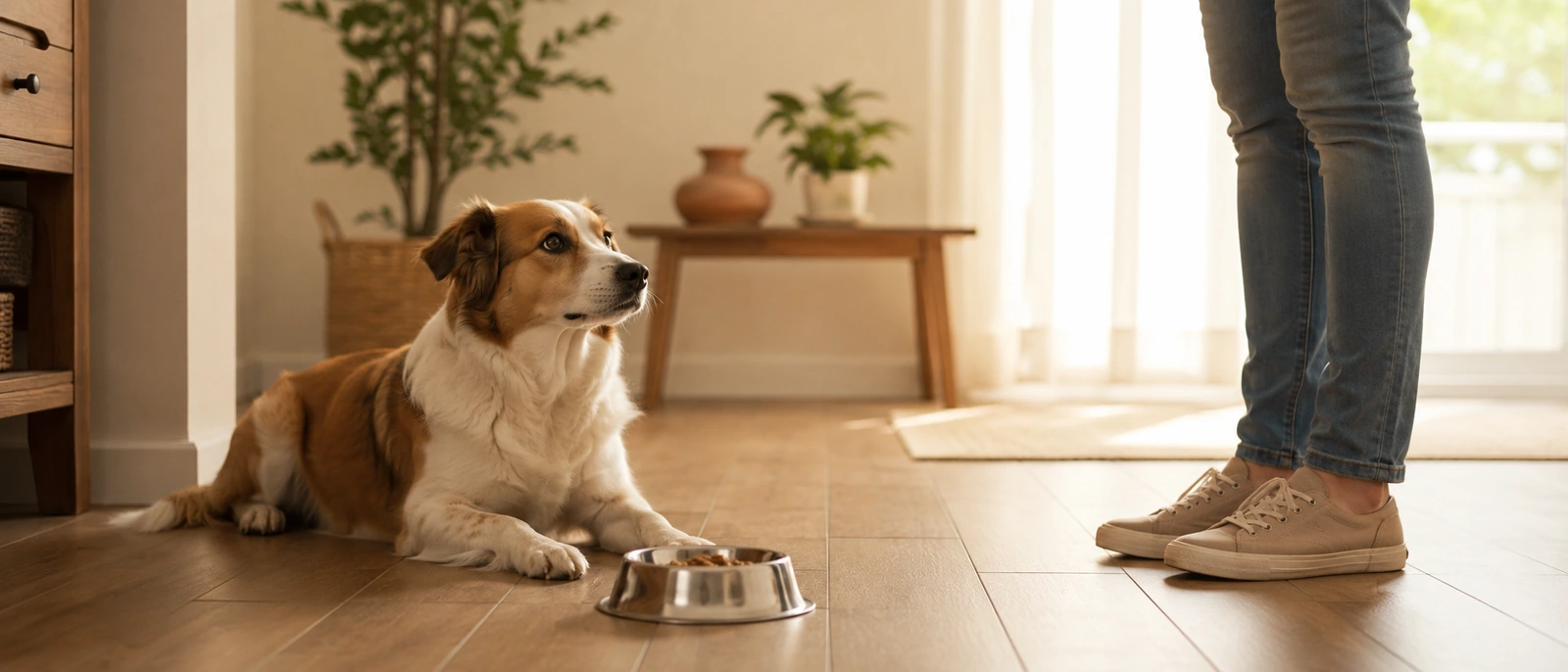
What Is Resource Guarding?
Resource guarding is a dog's attempt to keep something it values — using body language, sound, or in more serious cases, teeth — away from a person, another dog, or both. It's not a personality flaw or a sign of a "bad dog": the ASPCA's guidance on food guarding is direct on this point — "guarding possessions from humans or other animals is normal behavior for dogs." It shows up on a spectrum, from a dog that simply eats a little faster when you walk by, to a dog that bites when approached near a bone.
Dogs commonly guard several kinds of things, including:
- Food and food bowls
- Toys, chews, or "found" objects (a tissue, a sock, something off the counter)
- Space — a bed, a crate, a favorite corner of a couch
- People — guarding a specific person from other dogs, other people, or even other family members
Is This Normal, or a Red Flag?
Before any training advice, it helps to know what you're actually dealing with — and to be honest about where the line is between "something to work on carefully at home" and "something that needs a professional first." This guide draws that line conservatively on purpose, because the cost of guessing wrong is a bite.
Early / low-risk signals — the at-home guidance in this article may be a reasonable starting point: eating faster when approached, a stiff body or "freeze" over an item, a hard stare or showing the whites of the eyes ("whale eye"), moving the item away from you. These are body-language-only signals, with no growling or teeth involved.
Signs that call for a qualified behavior professional before you try anything at home: any growling (including a single instance — a growl is a real communication signal, not just "being cautious"), lifting a lip, snapping (with or without contact), lunging, any bite, guarding that shows up across multiple contexts (food, toys, and space, or toward multiple people), guarding around children, or any situation where you don't feel confident managing it safely. See the full list in When to Call a Professional.
If what you're seeing includes anything from that second list, skip ahead to that section now rather than continuing with the at-home guidance below — this article's home progression is written specifically for early, pre-aggression, clearly low-risk guarding, not for a dog that has already growled, snapped, or bitten. For dogs that do qualify for the at-home approach, the rest of this guide covers dog training for resource guarding step by step, starting with why it happens.
For a second, plain-language overview of this same topic, the ASPCA's guidance on food guarding is a reasonable companion read, particularly if food is the specific trigger in your home.
Why Do Dogs Resource Guard?
The Root Cause
Guarding is not evidence of a dog trying to "dominate" the household, and it's not a sign your dog is trying to be "alpha." The AVSAB's position statement on the use of dominance theory is direct about this: "the majority of behaviors owners want to modify... are not related to valued resources" in the rank-seeking sense dominance theory assumes, and the statement identifies fear, not dominance, as the real driver behind most aggressive behavior — stating plainly, "the most common cause of aggression in dogs is fear." The same statement warns that confrontational techniques (an alpha roll, staring the dog down, physical corrections) frequently provoke an aggressive response and can "directly exacerbate the problem by increasing the animal's fear or anxiety" — which is why guarding is better addressed as a fear- or anxiety-driven behavior (the dog is worried about losing something) than confronted as a battle over rank.
Which Dogs Are More Prone to It?
Resource guarding is reported across a wide range of breeds and mixes, and the ASPCA's own guidance on the subject doesn't single out particular breeds as more prone to it — it discusses guarding purely in terms of individual dogs and their history (for instance, noting that puppies raised in competitive feeding situations, like a large litter, are more likely to develop the behavior). We haven't found strong, credible research specifically ranking breeds by resource-guarding risk, so this article doesn't make that claim either. Be cautious of any source that confidently lists "guarding breeds" — that framing isn't well supported by what's actually been published on this specific behavior, and it can lead owners to either dismiss a real risk in a breed assumed to be "friendly" or unfairly stigmatize an individual dog that's never shown a guarding response.
"My Dog Started Guarding Out of Nowhere"
A sudden change is one of the more searched — and least answered — questions about this topic, so it's worth addressing directly.
If guarding starts suddenly, or existing guarding suddenly gets more frequent or intense, a veterinary visit should be your first step — not a last resort. The AVSAB's own guidance on this exact question is direct: sudden behavior changes, especially in adult dogs, frequently signal underlying pain rather than a primary behavior problem, and painful dogs often "rely on other forms of communication such as growling or baring their teeth" instead of simply moving away. The same resource notes pain can "wax and wane," so a dog might tolerate something one day and not the next — which can look exactly like guarding that "came out of nowhere." Ruling out a medical cause before treating this as a purely behavioral issue is the responsible starting point, and it's a step a training plan alone can't substitute for.
Once a medical cause has been ruled out or addressed, other possibilities are worth considering, though the evidence behind them varies:
- A new, unusually high-value resource. A dog that's never guarded a kibble bowl might guard a raw bone or a stolen sandwich. (This is a common-sense observation rather than a researched claim.)
- Adolescence. There's real research on dogs going through a developmental period around puberty — work from the University of Nottingham's Asher Behaviour Lab found dogs around eight months and older were more likely to ignore commands and became harder to train during this window. That research is about general trainability and obedience, not resource guarding specifically — we haven't found a study directly linking adolescence to new-onset guarding — but it's a genuine, studied phase of behavioral change, and some owners do report guarding shifting during it. Treat this one as a plausible contributing factor, not a confirmed cause.
- A household change. A new pet, a new baby, a move, or a change in routine can increase a dog's general anxiety, which can show up as guarding. (Common-sense observation, consistent with the fear/anxiety framing above, not a specific cited finding.)
- History before you knew the dog. In rescued or previously under-resourced dogs, guarding can reflect real scarcity in the past, even if the current home is stable and safe. (Widely discussed in rescue and shelter behavior circles; treat as plausible context rather than a proven mechanism.)
None of these make the behavior something to ignore — and a sudden or significantly worsening change is also, on its own, one of the reasons to involve a professional rather than working through it alone. See When to Call a Professional.
Resource Guarding Toward People
This section is written for early, pre-aggression, clearly low-risk guarding only — the "early / low-risk signals" described above: stiffening, freezing, whale-eye, moving the item away, with no growling, lip lifting, snapping, or biting involved. If your dog has already growled, snapped, lunged, or bitten, this isn't the right starting point — go to When to Call a Professional instead.
Trade-Up and "Add, Don't Take"
The foundation of most force-free resource-guarding work is simple in concept: instead of taking things away from your dog, you make your approach predict something better being added, not something being removed. Over time, a dog that's learned "person approaching = I might lose this" relearns "person approaching = something good happens, and I usually still get to keep what I have."
This general approach — desensitization paired with counterconditioning, rather than confrontation or "testing" the dog by taking things away — matches what the ASPCA specifically recommends for food guarding: a structured program that gradually acclimates a dog to a person's presence near food while pairing that presence with better food, so approach comes to predict something good rather than a threat. The AVSAB's position statement on humane dog training independently backs the same method choice at a policy level, specifically endorsing "systematic desensitization (as opposed to flooding or exposure)" and reward-based methods for behavior modification generally, while stating there's "no evidence that aversive training is necessary for dog training or behavior modification."
A Step-by-Step Desensitization Progression
Important: this is a criteria-based progression, not a fixed schedule. Don't advance because a certain number of days have passed — advance only when your dog consistently meets the success criteria at the current step. If your dog shows a mild body-language stress signal (stiffening, freezing, whale-eye) at a step, that's information, not failure: hold at that step, or go back one, and get more repetitions in before trying to move on. If your dog growls, lifts a lip, snaps, or does anything beyond a mild body-language signal at any point, stop the progression entirely and move to When to Call a Professional — that's no longer within the scope of this section. Some dogs move through the low-risk steps in days; others need weeks per step. That's normal and it isn't a sign the plan has failed.
This progression assumes a dog at the early, low-risk end of the spectrum, working with food as the example resource (the same structure applies to toys/objects with adjustments). Always start at a distance and intensity where your dog is already comfortable — if you're not sure where that is, start farther away than you think you need to.
- Step 1 — Approach and toss. From a distance your dog is relaxed at, walk toward your dog while it has its bowl, toss a higher-value treat toward (not directly into) the bowl, and walk away. Success criteria to advance: your dog's body stays loose, tail relaxed, no stiffening or guarding response, across multiple separate sessions.
- Step 2 — Shorten the distance. Gradually decrease your starting distance, always tossing a treat and moving away. Success criteria to advance: the same relaxed response at each shorter distance, consistently, not just once.
- Step 3 — Approach and drop, then step back immediately. Walk up close enough to drop (not toss) a treat near the bowl, then retreat right away. Success criteria to advance: no hesitation or stiffening as you approach or as you retreat.
- Step 4 — Brief presence near the bowl. Stand near the bowl for a couple of seconds while your dog eats, add a treat, then step away. Success criteria to advance: your dog continues eating normally with you standing there, not just tolerating it with visible tension.
- Step 5 — Generalize. Repeat the steps that worked with different family members (adults only — this isn't a step for children to practice), different rooms, and eventually the actual resources your dog has shown guarding around, always starting back at an earlier step in a new context.
If at any point your dog's response gets worse rather than better, or you reach a step where you don't feel safe continuing, stop and move to the When to Call a Professional section below rather than continuing to push forward.
Common Mistakes That Make It Worse
- Repeatedly taking the item away "for practice." This confirms the dog's original fear (that people take things) instead of resolving it.
- Punishing a growl, if one happens. A growl is information, not the problem itself — it's your dog telling you it's uncomfortable before escalating further. As noted above, a growl also means you've moved past what this section covers, so the right response is to stop and involve a professional, not to punish it. PetMD's veterinarian-written guidance on growling (authored by a board-certified veterinary behaviorist) is direct about the risk: punishing a growl "may result in further aggression... baring their teeth, lunging, snapping, or even biting," and can "reinforce your dog's underlying fear or anxiety" rather than resolve it.
- Moving too fast. Advancing steps based on a schedule instead of your dog's actual comfort is the single most common way owners accidentally make guarding worse.
- Testing severity by reaching for the item. This isn't training, and it risks a bite for no benefit — see severity triage instead.
Resource Guarding Toward Other Dogs
Management First
In a multi-dog household, the first and most important step isn't training — it's management. Feed dogs in separate spaces (different rooms, crates, or with enough distance that neither dog can reach the other's bowl), pick up high-value chews and toys when they're not directly supervised, and avoid situations where multiple dogs compete for a single valuable resource (one bone, one bed, one favorite toy).
Management can still fail, and guarding between dogs is one of the situations most likely to escalate into a fight. Know how to safely break up a dog fight before you need it — reaching in with hands or grabbing collars is how people get bitten, and the safer alternatives depend on barriers and distance being ready in advance.
A Basic Approach for Multi-Dog Households
Once management is solid, the same criteria-based, go-slow principle from the human-directed progression above applies between dogs — but it's meaningfully harder to run safely, because you're managing two animals' body language and two potential escalation points at once, often at a distance and speed a person can't always intervene in fast enough. This is genuinely one of the areas where getting a qualified behavior professional's in-person guidance early is worth it, rather than working purely from a written guide.
What Not to Do
None of the following are legitimate resource-guarding fixes, regardless of what you may see recommended elsewhere:
- Alpha rolls, pinning, or scruffing to "show the dog who's boss"
- Forcibly taking items away as a show of authority
- Repeatedly removing food or toys "to practice" (see above)
- Physical punishment or confrontation in response to a growl or snap
- Prong collars, choke chains, or e-collars used for this issue
- Treating a bite-history dog's guarding as something to simply "manage around" indefinitely without professional input
When to Call a Professional
This list is PupperGuide's own deliberately conservative safety threshold. It isn't a verbatim quote from any single professional body, but it's built on a point that is well-established in the field and directly confirmed by veterinarian-authored guidance on growling: a growl is a genuine warning signal, and treating it as anything less risks the exact outcome you're trying to avoid. Call a qualified behavior professional — rather than continuing to work through this at home — if any of the following apply:
- Any growling, including a single instance. A growl is a real communication signal, not just a dog "being cautious" — it means the dog is already past the early/low-risk stage this guide's at-home section covers.
- Lip lifting.
- Snapping, with or without contact.
- Lunging.
- Any bite, or any incident where skin was broken. This changes the risk calculus entirely; don't treat a bite as just a more serious version of a growl.
- There are children in the household. Guarding around kids is a different risk category than an adults-only home, regardless of how mild the behavior seems otherwise.
- Guarding shows up alongside other aggressive behavior — for example, a dog that also reacts aggressively to strangers or other dogs.
- A sudden, significant change in guarding behavior or severity — and see the note on ruling out medical causes first.
- You don't feel confident you can manage this safely. This is reason enough on its own — you don't need to meet any of the other criteria to justify getting help.
The at-home guidance in this article is written for early, low-risk signals only (see severity triage). It is not a substitute for in-person professional guidance once growling, snapping, lunging, or biting is part of the picture.
How to Find a Qualified Professional
Not all credentials are equally suited to aggression-adjacent behavior work like resource guarding, so it's worth knowing what to look for:
- DACVB (Diplomate, American College of Veterinary Behaviorists) — a veterinarian with board certification specifically in behavior. This is the highest level of expertise available and the right first call for anything involving a bite, a multi-dog household incident, or a case that also needs medication ruled in or out.
- CAAB or ACAAB (Certified / Associate Certified Applied Animal Behaviorist), certified through the Animal Behavior Society — non-veterinary behavior specialists with graduate-level training, where available in your area.
- CBCC-KA (Certified Behavior Consultant Canine – Knowledge Assessed), through the CCPDT — this is a distinct, more advanced credential than CPDT-KA, specifically focused on behavior consulting rather than general obedience training.
- A Certified Dog Behavior Consultant (CDBC) through IAABC — look specifically for one who lists aggression or resource guarding experience, not just general behavior consulting.
A plain CPDT-KA (Certified Professional Dog Trainer – Knowledge Assessed) credential on its own does not indicate aggression-specific expertise — it's a solid baseline credential for general training, but resource guarding sits closer to behavior modification than basic obedience. If you're considering a CPDT-KA trainer for this issue, ask directly about their specific experience with resource guarding or aggression cases before hiring them, rather than assuming the base credential covers it.
For anything involving a bite, ask your veterinarian for a referral to a DACVB or a veterinary behaviorist directly — this is the most reliable path when medical causes also need to be ruled out. The AVSAB's guidance on choosing a trainer lays out what to look for — including confirming reward-based methods and observing a class before committing — and is worth reading in full before you hire anyone.
FAQ
How do I stop my dog from resource guarding?
For early, low-risk signals only (stiffening, freezing, moving away with an item — no growling or teeth involved), a gradual, criteria-based desensitization approach can be a reasonable at-home starting point. If your dog has growled, snapped, lunged, or bitten, or there are children in the household, start with a qualified behavior professional rather than a DIY approach — see When to Call a Professional.
Can resource guarding be trained out of a dog?
Many early, low-risk cases improve significantly with consistent, structured work. It's more accurate to say guarding can usually be managed and reduced than to promise it's ever fully "cured" — and for some dogs, a management-plus-training combination, often with professional guidance, is the realistic long-term picture rather than a permanent DIY fix.
Is resource guarding a red flag?
Early, low-risk signals (stiffening, eating faster, moving an item away, with no growling or teeth involved) are common and not, on their own, a sign of a dangerous dog. Growling, lip lifting, snapping, lunging, or a bite are more serious signals that call for a qualified behavior professional rather than home management — see the severity triage section above.
Which dog breeds are more prone to resource guarding?
Resource guarding is reported across a wide range of breeds and mixes, and we haven't found strong, credible research ranking specific breeds by risk for this particular behavior. Individual history and circumstances — like early competitive feeding — are what the available guidance actually points to, not breed. Be skeptical of any source that confidently names "guarding breeds."
At what age do dogs start resource guarding?
It can appear at any age. Some owners first notice it or see it intensify around adolescence — research shows dogs around eight months and older go through a genuine developmental phase with real behavioral changes, though that research is about general trainability rather than resource guarding specifically, so treat the connection as plausible rather than proven.
Related Guides
- Why dogs dig and how to stop it — safely manage burying behavior without taking valued items by force.
- Crate Training a Puppy — a crate can be part of a safe, low-conflict space as you work through a management plan.
- Reactive Dog Training — a related fear-driven behavior issue with a similar desensitization-based approach; worth reading if your dog reacts to other dogs or people beyond just guarding.
- Dog Aggression Training — if guarding shows up alongside other aggressive behavior, or your dog's escalation criteria above are met, this diagnostic and referral-focused guide covers the broader category and how to get the right help.