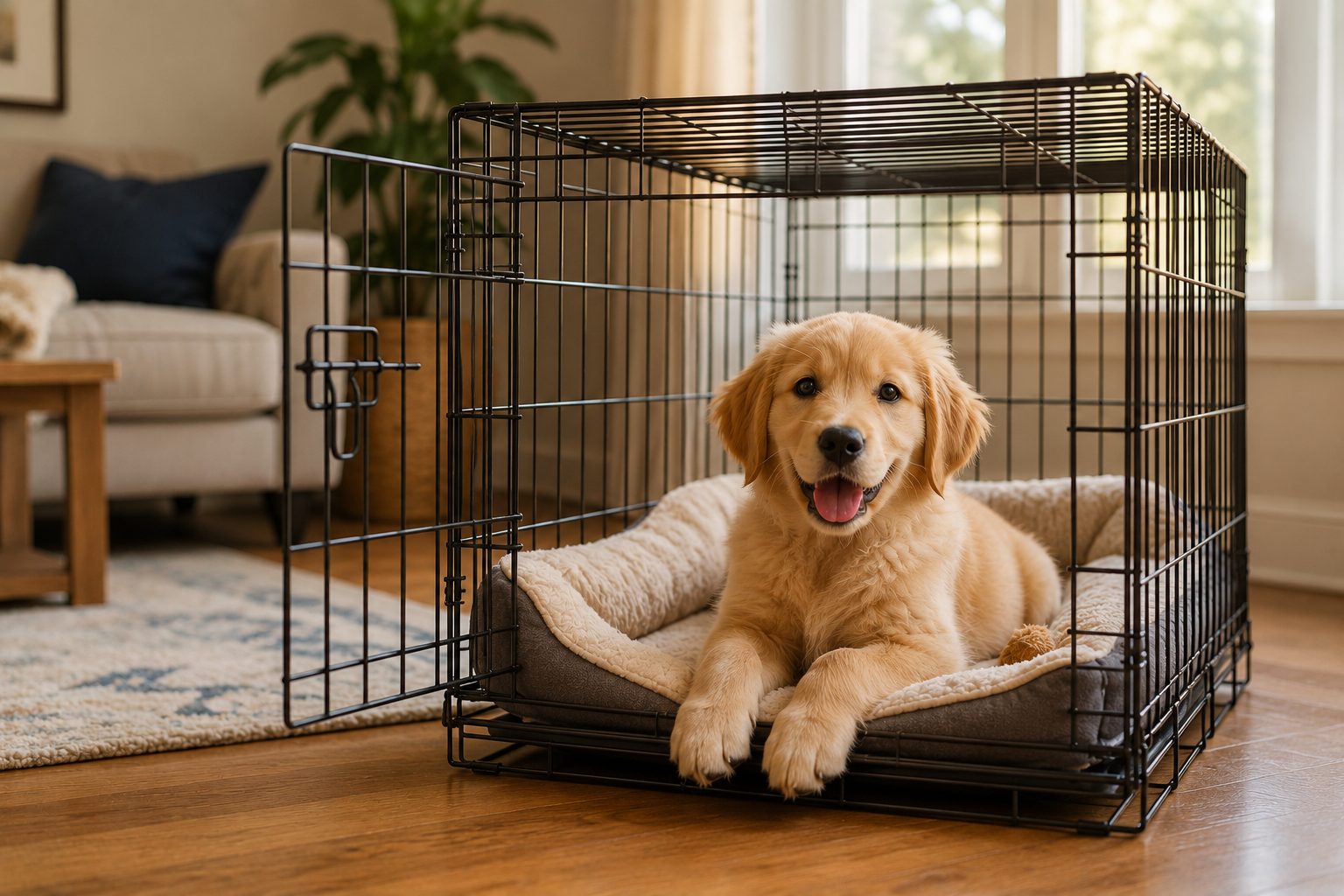
Crate training a puppy works best as a gradual progression: make the crate comfortable, reward your puppy for choosing it, close the door for seconds before minutes, and increase duration only when the puppy is relaxed. Never use the crate as punishment. Most early whining is adjustment, but distress that does not ease with a careful process—or includes frantic escape attempts, heavy drooling, or self-injury—deserves professional advice.
The schedule below is a set of criteria, not a promise that every puppy will be comfortable in ten days. Some puppies move quickly; others need several weeks. Your puppy is ready for the next step when they can repeat the current step calmly, not simply because a certain day has arrived.
Why crate training works
A crate can give a puppy a predictable place to rest, make supervision easier, and support a consistent potty routine. It should be a safe management tool, not a place for isolation or punishment. Cornell's Riney Canine Health Center guidance recommends introducing a crate positively and choosing one that allows a dog to stand, turn around, and lie down comfortably.
Crating does not replace exercise, attention, training, or bathroom breaks. A puppy still needs age-appropriate play, social contact, sleep, and regular opportunities to go outside. Think of the crate as one part of a routine that helps you prevent unsafe chewing and accidents while teaching the puppy how to settle.
Choosing the right crate
Measure your puppy from nose to the base of the tail and from the floor to the top of the head. Choose a crate that allows standing, turning, and stretching out, but avoid a size so large that the puppy can sleep in one end and toilet in the other. A divider panel is useful for a growing puppy because it lets the usable space expand without forcing you to buy a new crate every few months.
Wire crates offer airflow and visibility; plastic crates can feel more enclosed; and a sturdy exercise pen can be useful when a puppy needs more room than a crate provides. The safest choice is the one that is appropriately sized, well ventilated, secure, and easy to clean. Remove anything the puppy could shred or swallow.
Place the crate in a calm part of the home where your puppy can still see and hear the family. For the first nights, keeping it near your bed can make bathroom needs easier to hear and can reduce the shock of being separated from a new household. Do not place it in a hot, drafty, or isolated location.
A step-by-step crate training plan
Step 1: Make the crate voluntary
Leave the door open. Put a safe bed or mat inside and scatter treats near the entrance, then just inside it. Let your puppy go in and come out without being pulled, pushed, or trapped. Feed a few meals near the crate before moving the bowl farther inside. If the puppy will not enter, make the reward easier to reach and reduce pressure.
Step 2: Reward calm choices
When your puppy steps inside, mark the calm behavior with a quiet “yes” and offer a treat. Practice several short sessions rather than one long session. You can toss a treat out after the reward so the puppy chooses to return, rather than making the crate feel like a one-way door.
Step 3: Close the door for seconds
Once the puppy is comfortable entering, close the door for one or two seconds while they are eating, then open it before they become worried. Repeat at different times of day. Gradually work toward ten seconds, thirty seconds, and a few minutes, but only while the puppy remains relaxed. If the puppy starts pawing, rushing, or vocalizing intensely, make the next repetition easier.
Step 4: Build duration by criteria
Increase only one difficulty at a time: door closed, your distance from the crate, or the time your puppy stays inside. Do not increase all three together. A useful progression is door closed while you sit beside the crate, then while you stand, then while you move across the room, then while you briefly leave the room.
The success criterion is relaxed behavior: soft body language, normal breathing, willingness to eat, and the ability to settle. Mild protest is information that you may have moved too quickly; frantic behavior is a reason to stop and seek help if it keeps happening.
Step 5: Practice while you are home
Give your puppy a safe chew or food toy, sit nearby, and stand up for a few seconds. Gradually walk to another part of the room, then briefly out of sight. Return before the puppy escalates. These repetitions teach that the crate is ordinary and that your return is predictable.
Step 6: Add short absences
Once your puppy can rest calmly while you move around the house, step outside for a very short absence. Change the duration rather than making every absence longer: five seconds, fifteen seconds, ten seconds, then thirty seconds. Keep departures and arrivals low-key. If a camera shows escalating distress, do not continue lengthening the absence; return to a duration that is calm and consult a professional if necessary.
Crate training at night
Take your puppy outside immediately before bed. Keep the crate close enough that you can hear a genuine bathroom need, and take the puppy out quietly when necessary. Avoid turning a nighttime break into a play session. In the morning, go outside before food, toys, or extended freedom.
Do not expect a young puppy to stay dry or comfortable for an adult-length night. If the puppy regularly wakes, has accidents, or cannot settle, shorten the interval and discuss the routine with your veterinarian. Overnight progress should follow calm daytime practice, not replace it.
If your puppy cries immediately after being placed in the crate, check the basics: bathroom need, temperature, hunger, discomfort, illness, and whether the crate is too large or too small. Do not assume every sound is a behavior problem, but do not teach that frantic escalation is the only way to be released either. Safety and a gradual plan come first.
What not to do
- Do not use the crate as a consequence for chewing, barking, or an accident.
- Do not force a frightened puppy inside or bang on the crate to stop vocalizing.
- Do not leave a collar or harness on if it could catch on the crate.
- Do not use the crate to avoid providing exercise, toilet breaks, or companionship.
- Do not leave a puppy crated for a period that exceeds their bathroom, comfort, or developmental needs.
- Do not use punishment-based training to suppress fear. The Humane World for Animals crate-training guidance emphasizes patience, positive association, and a crate that is not used as punishment.
The AVSAB humane dog-training position statement supports reward-based training and warns against methods that rely on fear, pain, or intimidation. That principle matters especially when a puppy is already worried about confinement.
Realistic timelines and duration
Some puppies begin choosing the crate within days; others need several weeks. The useful measure is relaxed behavior, not a promise that every puppy will sleep through the night in ten days. Move forward when your puppy can repeat the current step without escalating, and step back when the behavior becomes frantic.
A puppy's age, health, previous experience, and individual temperament all affect how long they can stay comfortable and how often they need to toilet. Use frequent breaks for young puppies and follow your veterinarian's advice for an individual dog. A crate is not a way to stretch a bathroom interval beyond what your puppy can manage.
Progress can be uneven. A puppy may settle in the kitchen but struggle when the crate moves to a different room, or manage daytime sessions but need more support at night. Treat each new location, duration, and absence as a separate training difficulty and go back to an easier step when needed.
When to call a professional or vet
Ask your veterinarian or a qualified behavior professional for help if distress is not easing after roughly two weeks of a carefully followed, gradual plan, or if your puppy shows frantic scratching, attempts to break out, heavy drooling, repeated panic, or self-injury. Sudden changes in crate behavior, pain, vomiting, diarrhea, or breathing problems also need veterinary attention.
Do not assume a puppy who cannot settle is simply being stubborn. Separation-related distress, pain, gastrointestinal discomfort, inadequate sleep, and an unsuitable confinement setup can look like “bad crate behavior.” A professional can help distinguish ordinary adjustment from a problem that needs a different plan.
Credentials to look for
For a straightforward manners or settling problem, look for a trainer who clearly explains reward-based methods, avoids intimidation, and can show how they will keep the puppy under threshold. For persistent fear, separation distress, or a safety concern, ask your veterinarian about a board-certified veterinary behaviorist (DACVB) or Certified Applied Animal Behaviorist (CAAB).
Other useful credentials may include Certified Behavior Consultant Canine-Knowledge Assessed (CBCC-KA) or Certified Dog Behavior Consultant (CDBC). Credentials do not replace a good fit: ask what methods are used, whether the professional will coordinate with your vet, and what the plan is if the puppy becomes more distressed.
FAQ
How long should crate training sessions be?
Begin with seconds or a few minutes and repeat while your puppy is calm. Increase gradually. The right duration is the longest period your puppy can handle without distress, not a fixed number that applies to every dog.
Should the crate be in the bedroom?
It can be helpful during the first nights because you can hear bathroom needs and reassure a puppy without turning the break into a long interaction. Move it later if you prefer another location, using the same gradual approach.
What if my puppy whines?
Check first for a bathroom need, illness, heat, discomfort, or a crate problem. If the puppy is safe and merely protesting, wait for a brief quiet moment before opening when practical, then make the next practice session easier. Persistent panic is not a training failure to punish; get help.
Can a crate help with potty training?
It can support supervision and a routine, but it does not replace frequent outdoor trips. Pair it with a consistent puppy potty-training schedule and close observation.
How do I crate train a puppy at night?
Practice during the day first, take the puppy outside before bed, keep the crate near you initially, and respond to genuine bathroom needs quietly. If nighttime distress remains intense, stop increasing duration and ask your veterinarian or behavior professional for help.
Related guides
- Puppy sleep schedule by age — plan naps and bedtime around crate practice without overusing confinement.
- How to potty train a puppy
- Why your puppy won't stop barking
- Reactive dog training