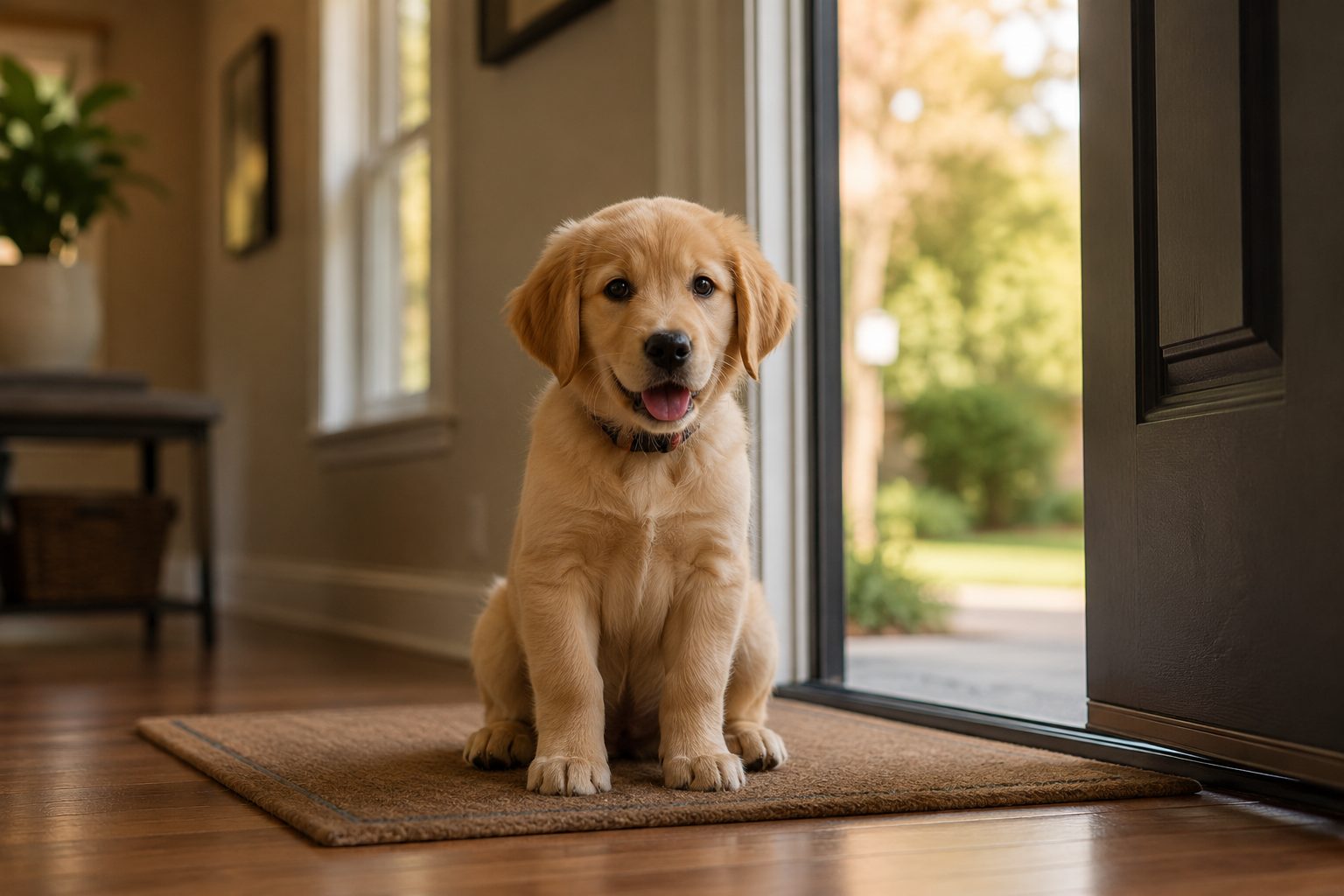
To learn how to potty train a puppy, build the day around predictable bathroom trips, close supervision, and immediate rewards. Go outside after waking, eating, drinking, playing, and napping, plus regularly between those events. If your puppy was previously reliable and suddenly starts having accidents, treat that as potty training regression rather than simply repeating the first-week plan; a veterinary check may be appropriate.
Successful house training is mostly a management system. Your puppy needs enough chances to succeed, a clear place to go, and a calm consequence when an accident happens. The goal is not to catch and punish mistakes; it is to prevent most mistakes while teaching the behavior you want.
The puppy potty-training schedule that works
Choose one outdoor bathroom area and take your puppy there on leash. Keep the trip boring until the puppy finishes, then reward immediately with praise, a treat, or a short sniff. A puppy who does not go should return to close supervision or a safe pen for a short period before trying again.
Use a written or phone-based log for meals, water, naps, outdoor trips, successful toileting, and accidents. The goal is to learn your puppy's pattern and take them out before the next accident, not to wait for a perfect signal. Many puppies do not reliably signal until the routine is already well established.
As a starting point, young puppies often need breaks every one to two hours while awake, with extra trips after the events above. This is a flexible starting point, not a guarantee. Weather, excitement, health, diet, sleep, and the individual puppy all matter. The Humane World for Animals potty-training guide recommends consistency, supervision, praise, and avoiding punishment.
The essential outing sequence
- Take the puppy to the same toilet area.
- Give them a few quiet minutes to sniff and eliminate.
- Reward immediately when they finish, while you are still outside.
- Allow a brief sniff or play period after the reward so the puppy does not learn that toileting ends all outdoor time.
- If they do not go, return to supervision and try again rather than giving unsupervised freedom.
Keep food, water, sleep, and play reasonably predictable while training. You do not need to restrict normal water access; instead, include drinking in your schedule and ask your vet about any unusually high or low intake.
Week-by-week expectations
Week 1: Prevent and observe
Keep the puppy close enough to supervise. Watch for sniffing, circling, wandering away, sudden stillness, or heading toward a previous accident spot. Take the puppy out before the usual accident time and record what happens. Use a small, safe area when you cannot actively watch.
The first week is not a test of whether your puppy is “trained.” It is a period for discovering timing, choosing a consistent toilet location, and making outdoor success rewarding. Expect mistakes, especially after excitement or a change in sleep.
Weeks 2–3: Extend carefully
If the puppy is succeeding, add small amounts of freedom one room at a time. Keep the schedule after waking, meals, play, and naps even when accidents become less frequent. If accidents increase, reduce freedom and shorten the interval again.
Begin watching for a signal such as standing near the door, looking at you, sniffing in a particular way, or pacing. Prompt the puppy to the door before the signal becomes urgent, then reward the outdoor result. A signal is useful, but it should supplement—not replace—your schedule.
Week 4 and beyond: Generalize
Practice the same routine in new rooms and homes. Continue rewarding outdoor success and supervising during exciting visitors, travel, or changes in routine. Reliability is a pattern built over time, not a single accident-free weekend.
What to do when an accident happens
If you catch the puppy beginning to go, interrupt calmly with a neutral sound and take them outside. If they finish outdoors, reward immediately. If you find an old accident later, say nothing to the puppy; clean it and return to closer supervision.
Avoid shouting, rubbing a puppy's nose in the mess, or punishing after the fact. The AVSAB humane dog-training position statement recommends reward-based training and explains why aversive methods can create fear and interfere with learning.
Clean the area according to the cleaner's directions and remove odor as thoroughly as possible. If a puppy repeatedly chooses one spot, block access while retraining and consider whether the location is quiet, easy to reach, and sufficiently cleaned. Avoid making a precise scientific claim about one cleaner type; the practical goal is to remove the odor and prevent another rehearsal.
Potty training regression
Regression means a puppy or dog that was doing well starts having accidents again. First review ordinary causes: a longer interval, too much unsupervised freedom, a move, visitors, travel, a schedule change, excitement, fear outdoors, or an inconsistent household routine. Return temporarily to the last routine that worked and reinforce success.
Do not assume every regression is behavioral. VCA Animal Hospitals' guidance on house-soiling explains that medical problems can contribute to new indoor elimination. Contact your vet promptly if the change is sudden, persistent, unusually frequent, involves straining or blood, or occurs with changes in thirst, appetite, energy, stool, or comfort. A previously reliable adult dog with a sudden change especially deserves a medical discussion.
When you call, write down when the accidents occur, whether they are urine or stool, the approximate amount, any change in water intake, and what happens immediately beforehand. That information helps separate a schedule problem from a possible medical or anxiety-related problem.
What not to do
- Do not punish an accident discovered after it happened.
- Do not give the puppy the whole house before they can succeed in a smaller area.
- Do not rely on a signal you have not taught and observed consistently.
- Do not make outdoor toilet trips so entertaining that the puppy forgets why they went out.
- Do not keep extending intervals simply because the puppy succeeded once.
- Do not restrict water as a shortcut or ignore repeated night waking.
Puppy pads can be useful where outdoor access is genuinely limited, but they may create a second transition if the long-term goal is outdoor toileting. Choose one clear routine and apply it consistently. If pads are necessary, place them in one predictable location and transition gradually rather than moving them randomly.
When to call a vet or trainer
Speak with a veterinarian for sudden regression, painful urination, repeated straining, blood, marked thirst, lethargy, vomiting, diarrhea, weight change, or any concern that the puppy is unwell. A reward-based trainer can help when the schedule is difficult to maintain, the puppy is fearful outdoors, or accidents continue despite careful supervision and a veterinary check.
Do not wait for a training appointment if a puppy seems painful, cannot urinate or defecate normally, or is showing a broader change in health. Potty training should never be used to explain away a medical warning sign.
Credentials to look for
For routine house-training support, choose a trainer who explains reward-based methods, gives you a management plan, and does not use humiliation or physical corrections. For fear of going outside, severe anxiety, or a problem that continues after a veterinary check, ask your veterinarian for a referral to a qualified behavior professional.
Useful credentials may include Certified Behavior Consultant Canine-Knowledge Assessed (CBCC-KA), Certified Dog Behavior Consultant (CDBC), Certified Applied Animal Behaviorist (CAAB), or board-certified veterinary behaviorist (DACVB). Ask what the professional will do if the puppy becomes more fearful and whether they will coordinate with your veterinarian.
FAQ
How often should I take a puppy outside?
Start with after waking, meals, drinking, play, and naps, plus regular breaks while awake—often every one to two hours for a young puppy. Adjust from your log rather than relying on a rigid formula.
How long does potty training take?
Progress varies widely. Many puppies become substantially more reliable over several months, but full reliability depends on age, health, routine, supervision, and the individual dog. Keep rewarding the behavior you want.
What should I do if a trained puppy starts having accidents?
Return to close supervision and the last successful schedule, then look for routine changes. If the change is sudden, persistent, or paired with urinary or general health symptoms, contact a veterinarian instead of treating it as disobedience.
Is there a “10-10-10” potty-training rule?
Treat fixed formulas as reminders, not veterinary rules. A puppy's needs vary with age, size, health, diet, sleep, and activity. A simple log and a flexible schedule are safer than forcing every puppy into the same numbers.
Should I use a crate?
A properly introduced crate can support supervision and rest, but it is not a substitute for frequent bathroom opportunities. See our complete crate-training guide.
Related guide
- Puppy sleep schedule by age — coordinate naps, nighttime toilet breaks, and wake-up routines.
- Crate training a puppy